
2026 DataviCloud vs. 6sense Comparison

DataviCloud vs. 6sense: The 2026 Guide to Enterprise Revenue Orchestration
In the 2026 go-to-market (GTM) landscape, navigating the "dark funnel" is no longer an option or a mystery-it is a baseline requirement for enterprise growth. For modern Revenue Operations (RevOps) leaders, the primary challenge has evolved from basic intent identification to orchestrating a seamless, unified response across increasingly complex and fragmented tech stacks.
As organizations evaluate the heavyweights of GTM intelligence in 2026, two primary platforms dominate enterprise evaluations: 6sense, the established pioneer of account-based orchestration, and DataviCloud, the emerging leader in unified revenue intelligence.
1. The Evolution of GTM Intelligence: Context for 2026
By 2026, the traditional "intent data" category has matured into full-scale revenue orchestration. Simply knowing that an account is searching for specific industry keywords is no longer sufficient to secure a competitive edge. Modern platforms must accurately predict the specific buyer individual, isolate their precise operational pain point, and prescribe the exact sequence of multi-channel actions required to advance and close the opportunity.
While 6sense established its market dominance by uncovering anonymous intent, DataviCloud entered the market with a "unified-first" architecture designed to eliminate the operational friction between initial data acquisition and final execution.
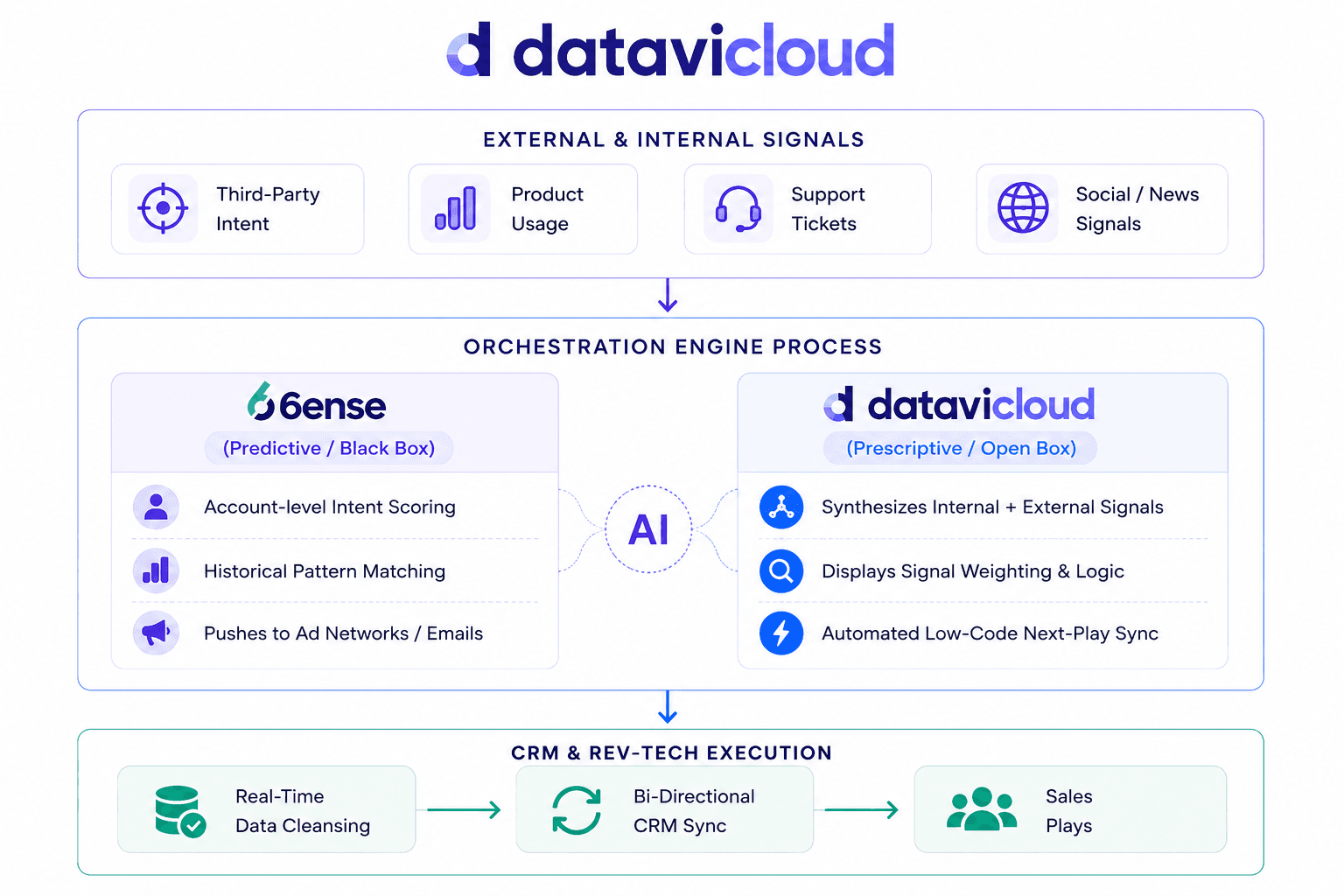
Architectural Signal Processing & Execution Model
Feature-by-Feature Deep Dive
1. AI Capabilities: Predictive vs. Prescriptive
6sense - The Revenue AI Powerhouse: 6sense’s predictive AI engine relies on a vast historical dataset to accurately forecast "in-market" buying stages. In 2026, 6sense focuses heavily on AI-driven display advertising and conversational email automation. However, RevOps teams frequently report a "black box" experience, where the underlying logic of the 6sense Score remains opaque and difficult to unpack for custom sales plays.
DataviCloud - Autonomous Orchestration & Signal Synthesis: DataviCloud differentiates itself through transparent, prescriptive AI. Instead of merely scoring accounts, its core engine synthesizes internal operational signals (such as product usage and support tickets) alongside external signals (intent data, social activity, and news) to prescribe or automate specific actions. Its "open-box" model reveals the explicit weighting behind every signal, building trust with front-line sales representatives.
2. Data Accuracy and Identity Resolution
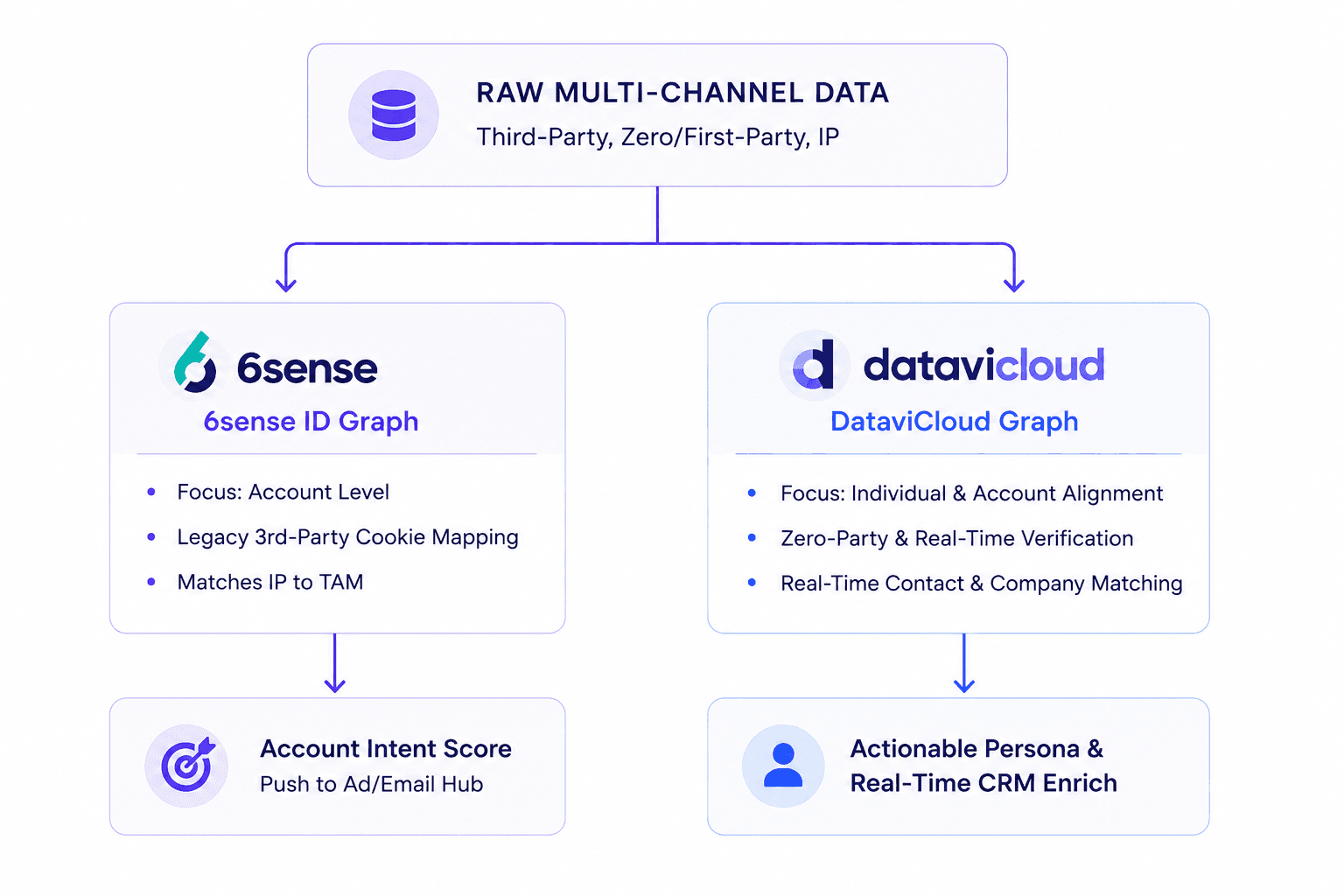
6sense - Account-Centric Graph: 6sense excels at account-level identification using its patented ID Graph to connect anonymous IP traffic to enterprise companies. However, as privacy regulations (such as GDPR 2.0 and updated CCPA guidelines) tightened leading into 2026, 6sense's historical reliance on third-party cookies has necessitated greater investment in first-party data integrations.
DataviCloud - Unified Identity Graph: Engineered for the post-cookie era, DataviCloud uses a zero-party data framework that prioritizes direct integrations and real-time contact verification. While 6sense focuses heavily on the account entity, DataviCloud links accounts directly to individual decision-makers with high precision, reducing email bounce rates and ensuring precise revenue attribution.
3. CRM Integration and Ecosystem Agility
6sense - Deep but Complex: 6sense provides deep integrations with core platforms like Salesforce and HubSpot. However, maintaining these connections requires significant administrative overhead—often referred to by RevOps teams as the "6sense tax" to prevent data duplication and maintain record alignment.
DataviCloud - Bi-Directional, Low-Code Sync: DataviCloud treats the CRM as a living, dynamic ecosystem. Its headless, bi-directional architecture synchronizes data in real time with minimal API latency. Additionally, an integrated native data-cleansing layer enriches and deduplicates records automatically before intent signals are delivered to the CRM.
4. User Experience, Onboarding & Time-to-Value
Implementation Timelines: Enterprise deployments for 6sense typically require a high-touch, multi-month onboarding process (often taking 3 to 6 months) due to complex model training and ad platform configurations. Conversely, DataviCloud utilizes low-code connectors that enable teams to launch within 4 to 8 weeks.
Administrative Overhead & Adoption: While 6sense demands dedicated administrative oversight to manage custom configurations and taxonomy matching, DataviCloud's automated enrichment and transparent signal weighting reduce maintenance overhead for lean RevOps teams.
5. Data Privacy, Governance & Risk Management
Regulatory Compliance: Tightened data privacy laws in 2026 (including GDPR 2.0 and state-level CCPA updates) require strict compliance frameworks for intent data gathering.
Zero-Party vs. Third-Party Risks: 6sense has had to adjust its data ingestion framework to rely less on third-party cookie networks. In contrast, DataviCloud was natively designed around direct, consent-driven zero-party data and real-time contact validation, offering lower compliance exposure for global enterprise deployments.
6. Total Cost of Ownership (TCO) & Long-Term ROI
Pricing Structures: 6sense operates on a tiered annual subscription model dictated by Total Addressable Market (TAM) size and module selection, which can lead to paying for unused feature bloat.
Consumption vs. Subscription: DataviCloud uses a consumption-based ROI model where fees are tied directly to the revenue signals acted upon and the records enriched. This directly aligns software expenditure with actual pipeline growth and tangible business outcomes.

Summary Comparison Table
Feature / Dimension | 6sense (2026) PDF | DataviCloud (2026) PDF |
Primary Focus | Account-based intent & display advertising | Unified revenue orchestration & execution |
AI Architecture | Predictive scoring ("Black Box" model) | Prescriptive scoring ("Open Box" transparency) |
Data Sourcing | Strong third-party data & account ID graph | Zero/first-party data & real-time verification |
Implementation | 3–6 months (High-touch / Complex setup) | 4–8 weeks (Low-code / Fast onboarding) |
CRM Synchronization | Batch / Scheduled updates (Requires ongoing admin) | Real-time bi-directional sync with built-in deduplication |
Pricing Strategy | Tiered annual subscription based on TAM & modules | Consumption/ROI-aligned based on signals & enrichment |
Choosing the Right Fit for Your GTM Strategy
Choose 6sense if: Your organization runs mature, high-touch ABM programs with heavy display ad budgets and dedicated RevOps teams equipped to manage complex administrative workflows and legacy data structures.
Choose DataviCloud if: Your team requires fast implementation, transparent and actionable AI recommendations, seamless bi-directional CRM integration, and a flexible pricing model tied directly to pipeline growth.
Recent Post





FAQ
Comment Section