
From Sales Execution to Revenue Orchestration with DataviCloud.

From Sales Execution to Revenue Orchestration with DataviCloud.
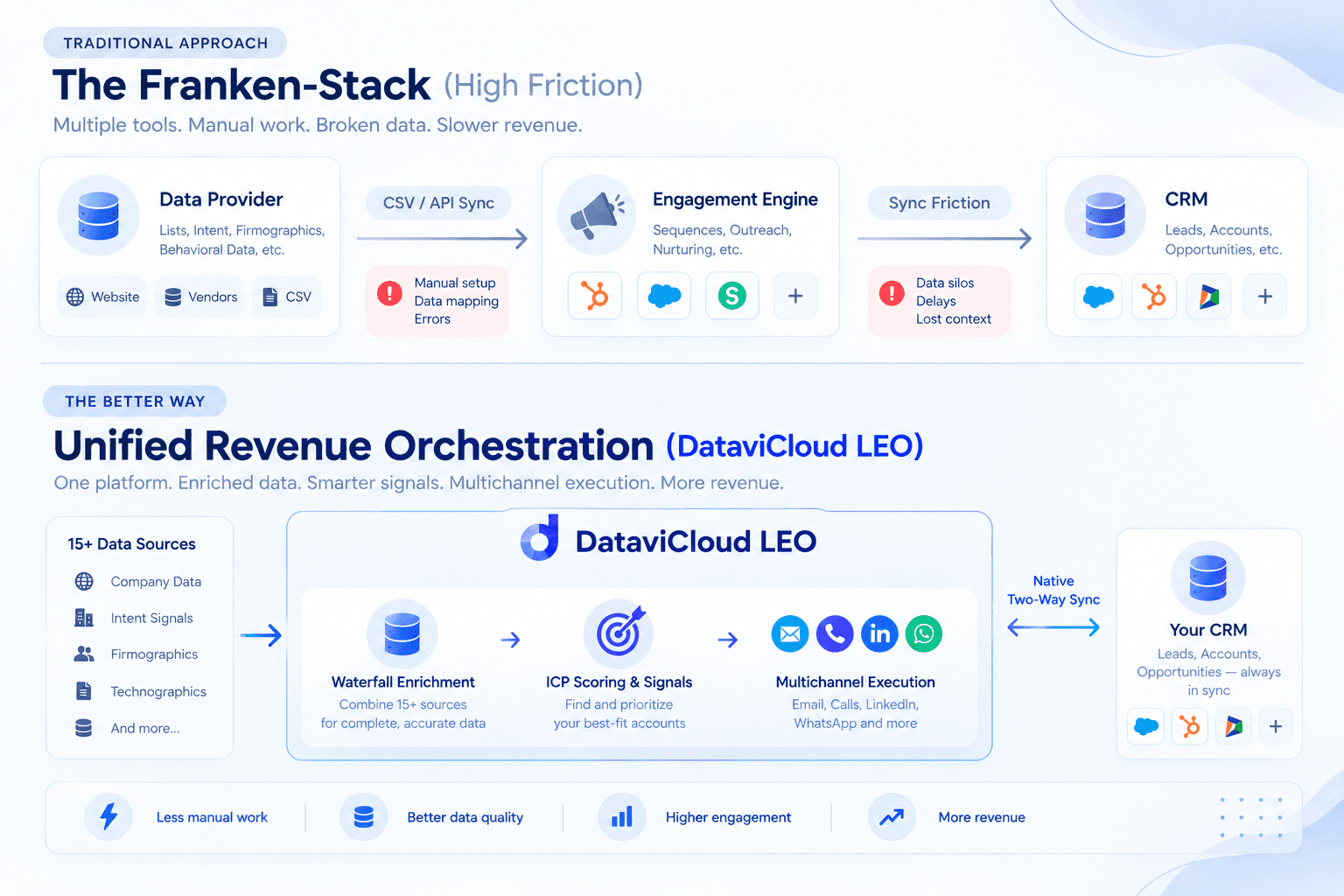
The traditional sales stack forces teams to stitch together separate data, engagement, and CRM tools, leading to sync breaks, duplicate records, and wasted rep research time. DataviCloud LEO replaces this "Franken-stack" with a unified engine that combines 15+ waterfall enrichment sources, AI-driven ICP scoring, and native deliverability directly into outbound execution.
1. Executive Summary & GTM Market Shift
For the past decade, the Sales Engagement Platform (SEP) was the foundation of the modern outbound tech stack. Tools like Outreach transformed how Business Development Representatives (BDRs) and Account Executives (AEs) engaged with prospects, replacing manual one-to-one emails with automated, multi-channel sequences.
However, the outbound environment has fundamentally changed:
Buyer Fatigue: High-volume, non-personalized sequencing yields diminishing open and reply rates.
Rapid Data Decay: B2B contact data degrades at ~30% annually, causing high bounce rates and domain reputation damage.
The "Franken-Stack" Tax: Managing a disconnected stack a standalone data provider, a separate sequencing engine, and a CRM adds significant financial, technical, and operational overhead.
The market is shifting from sheer Sales Execution (high-volume outreach) to Revenue Orchestration (signal-led, fully integrated, data-driven engagement).
2. The Outreach Era: Rise and Structural Limits of Traditional SEPs
When legacy sales engagement platforms launched, they solved a core operational challenge: scale. By consolidating email templates, task management, and call logging into automated sequences, they provided the industry with a dedicated execution layer.
As GTM motions matured, three structural limits of the execution-only model emerged:
The Data Gap: Legacy SEPs process and sequence contacts, but they do not natively source or enrich lead data. Revenue teams must purchase and maintain external data tools, manually export/import lists, and map custom fields.
The Integration Tax: Data moving across APIs between separate enrichment providers, SEPs, and CRMs frequently encounters sync failures, schema mismatches, duplicate records, and stale contact details.
Rigid, Linear Sequencing: Traditional SEPs rely on fixed, time-based steps. Adapting a sequence based on real-time buying signals or organizational changes usually requires manual human intervention.
3. What Is Revenue Orchestration?
Where sales engagement focuses on executing tasks, Revenue Orchestration determines which action to take, for which account, at what exact moment.
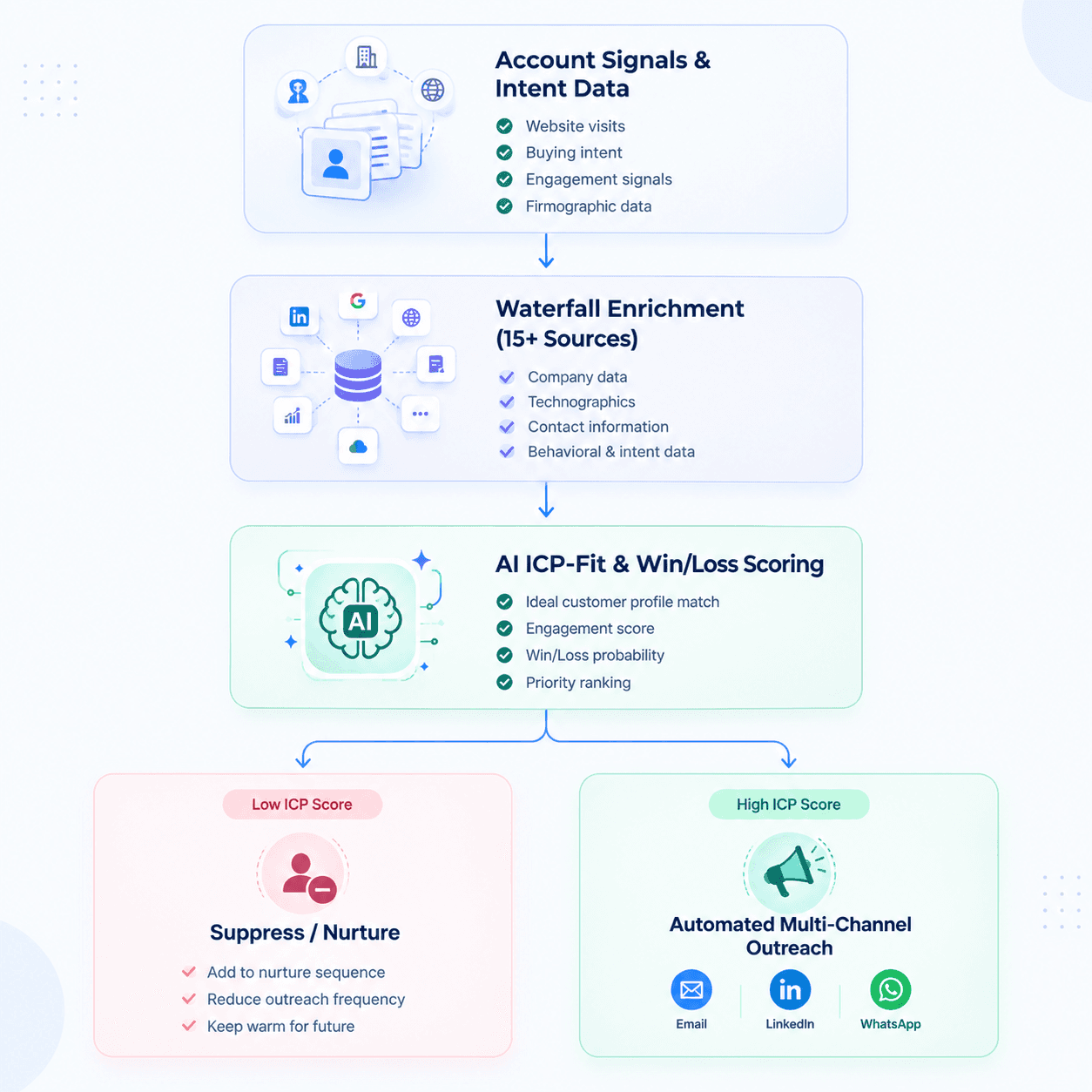
Instead of running sequences indiscriminately, Revenue Orchestration combines real-time data enrichment, intent signal processing, dynamic lead scoring, and automated execution into a single, continuous workflow.
4. Platform Deep-Dive: LEO by DataviCloud
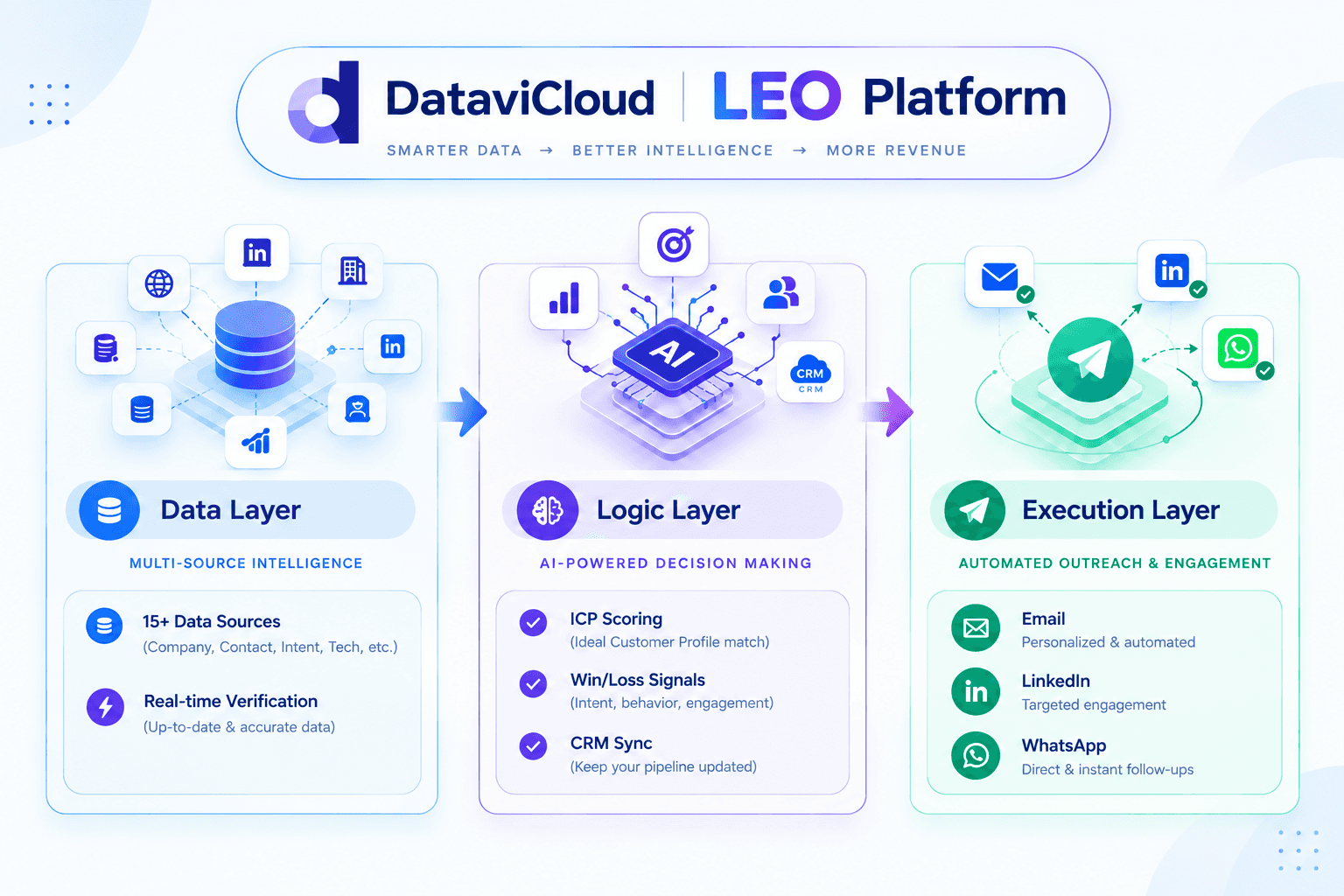
DataviCloud LEO consolidates data enrichment, lead scoring, and outbound execution into a unified engine.
4.1 Built-in Waterfall Data Enrichment
LEO replaces standalone data subscriptions with an integrated waterfall enrichment engine drawing from 15+ B2B data sources. It identifies, verifies, and enriches prospect records directly within the platform prior to campaign launch. Cleaned records sync bi-directionally with primary CRMs (Salesforce and HubSpot).
4.2 Signal-Based Intelligence & ICP Scoring
Instead of pushing leads through fixed cadences regardless of fit, LEO applies AI-driven ICP-fit scoring and win/loss signal analytics. This filters out low-probability accounts and prioritizes high-intent prospects for rep outreach.
4.3 Native Deliverability Infrastructure
To support multi-channel campaigns (Email, LinkedIn, WhatsApp), LEO includes built-in domain deliverability protocols - including SPF, DKIM, and DMARC alignment - reducing reliance on external deliverability add-ons.
5. Head-to-Head Architectural Comparison: LEO vs. Outreach
Feature Category | Outreach (Sales Engagement Platform) | LEO by DataviCloud (Revenue Orchestration) |
Core Architecture | Execution layer focused on outbound sequencing. | Unified platform combining data enrichment, scoring, and execution. |
Data Sourcing | Requires external data providers and third-party integrations. | Integrated waterfall enrichment leveraging 15+ data sources. |
Workflow Pipeline | Manual or scheduled import/export and field-mapping between tools. | Direct lead enrichment flowing into outreach with native CRM sync. |
Account Intelligence | Standard engagement metrics (opens, clicks, replies, basic sentiment). | Predictive ICP-fit scoring combined with win/loss signal analysis. |
Deliverability Control | Frequently requires third-party deliverability tools or manual monitoring. | Integrated SPF, DKIM, and DMARC deliverability management. |
Note: This architectural comparison reflects public capabilities as of 2026. Specific pricing and setup parameters should be verified directly with each vendor.
6. Business Impact & Measured GTM Performance
Eliminating integration steps between data sourcing, scoring, and execution reduces operational friction and list decay. Published customer benchmarks highlight the following operational improvements:
Cost Optimization: Demand generation teams have documented up to a 60% reduction in Cost-per-SQL over two quarters by transitioning to intent-driven targeting with LEO.
Rep Productivity: Sales development teams report reducing daily research time from ~45% of their working day to 15%, enabling a 40% increase in booked meetings.
7. Strategic Outlook
While traditional sales engagement platforms established the groundwork for automated sequencing, GTM motions increasingly demand unified data and execution. By bringing enrichment, predictive scoring, deliverability management, and outreach into a single platform, revenue orchestration systems like DataviCloud LEO streamline the tech stack - allowing GTM teams to focus on high-intent accounts.
Recent Post





FAQ
Comment Section