
The 2026 RevOps Shift: Why GTM Teams Rebuild Data Stacks

The 2026 RevOps Shift: Why High-Growth GTM Teams Are Rethinking Their Data Stack
If you lead a Revenue Operations (RevOps), Sales Operations, or Go-To-Market (GTM) team, you’ve likely felt a major shift across the enterprise sales landscape: "More leads" is no longer the key to scaling revenue.
Historically, B2B growth playbooks relied heavily on mass prospecting buying access to millions of contact records and feeding them into automated sales engagement sequences. However, in 2026, top-of-funnel lead saturation yields diminishing returns. If underlying account data is stale, duplicate, or disconnected from sales workflows, adding more prospects only creates operational friction.
Leading RevOps organizations have pivoted focus from data quantity to data quality. Rather than continuously buying static lead lists, high-growth GTM teams are auditing their underlying revenue architecture to eliminate the primary driver of missed targets: the leaky bucket CRM.
The Root Cause of Stalled Pipeline: The "Leaky Bucket" CRM
CRMs rarely deteriorate overnight; they suffer from compounding data decay. Standard operational changes gradually degrade data integrity across your tech stack:
Account Executive Turnover: Rep departures leave key enterprise accounts orphaned, stripping away historical context and relationship history.
Buyer Career Shifts: B2B contact data naturally decays at an estimated 25% to 30% per year as decision-makers change roles or companies. Read our real-world customer success stories on how growth teams prevent pipeline loss and eliminate data rot.
Shadow Database Creation: Disparate prospecting and outreach tools generate unverified contact silos that fail to sync cleanly back to your central CRM (e.g., Salesforce or HubSpot).
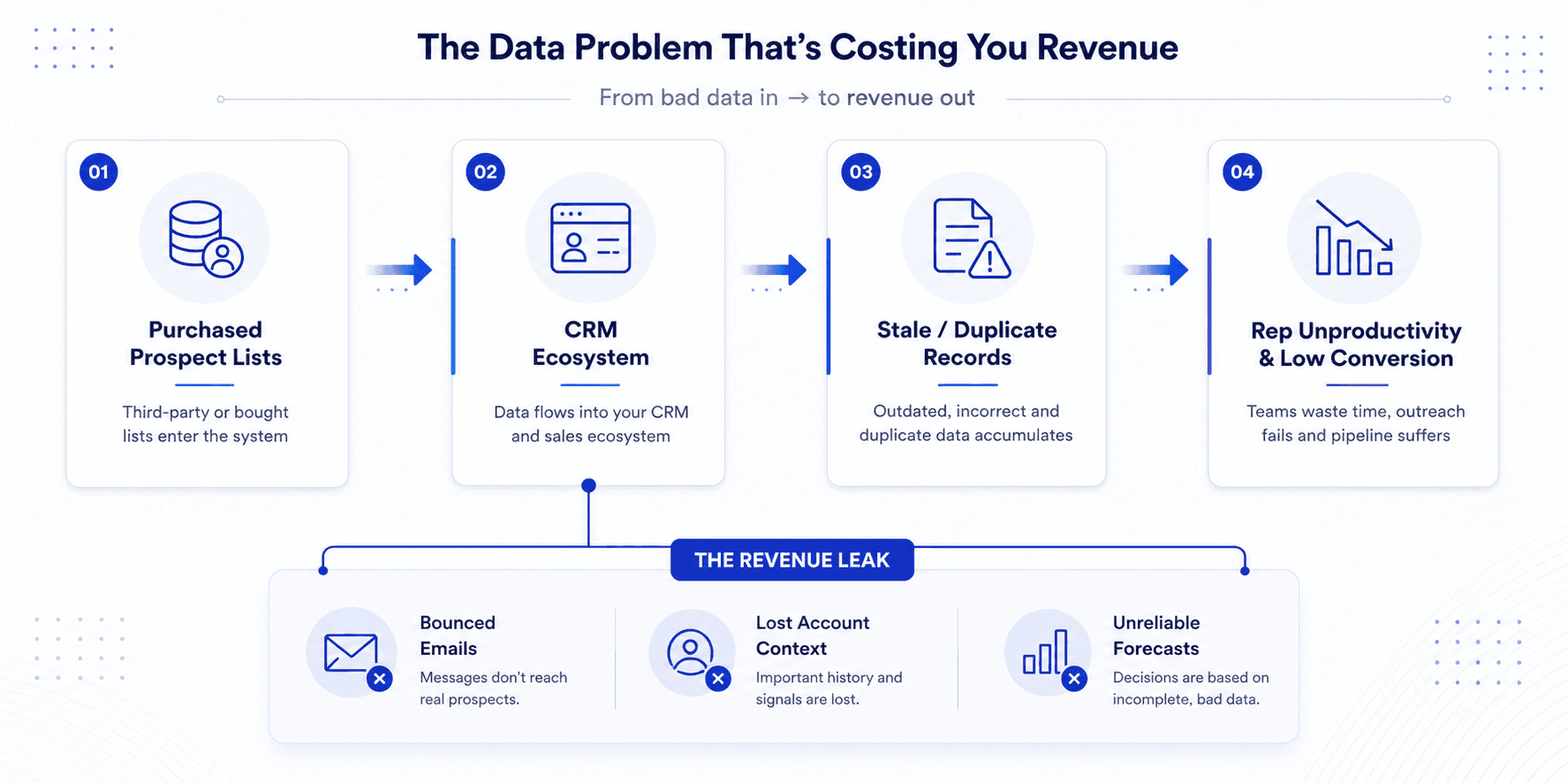
Traditional sales engagement platforms (SEPs) and outbound lead databases excel at generating raw contact volume. However, they are not architected to clean, orchestrate, or heal the data sitting inside your primary GTM stack.
Platform Comparison: Revenue Intelligence vs. Legacy Prospecting
To build a resilient revenue stack, GTM leaders must distinguish between legacy lead generation databases and modern, unified revenue intelligence platforms.
Strategic Capability | Modern Revenue Intelligence (e.g., DataviCloud) | Legacy Outbound Platforms (e.g., Apollo.io) |
|---|---|---|
Core Architecture Focus | GTM data unification & predictive revenue execution | High-volume list building & outbound sequence execution |
Data Hygiene Mechanism | Agentic AI continuous self-healing & multi-source verification | Static contact databases updated on periodic refresh cycles |
Pipeline Visibility | Multi-touch activity tracking across Web, CRM, Email, and Slack | Basic sequence metrics (open rates, click rates, standard stage updates) |
Forecasting Model | Predictive AI incorporating intent signals and activity completeness | Manual rep probability weighting based on standard stage milestones |
CRM Integration Layer | Deep bi-directional orchestration with dynamic deduplication | Standard point-to-point sync; often introduces duplicate records |
Target End-User | RevOps, Sales Ops, CROs, & Growth Executives | SDRs, BDRs, & individual outbound sales reps |
Strategic Difference: While legacy outbound tools inform SDRs who to contact, unified revenue intelligence platforms like DataviCloud demonstrate how modern tools tell revenue leaders why enterprise deals stall, which key accounts demonstrate genuine purchase intent, and how to deliver an accurate forecast to the board. Learn more about our vision on About DataviCloud.
What Makes DataviCloud Different: 3 Core Pillars
Modern RevOps architecture relies on three critical capabilities to eliminate data debt and maintain continuous alignment across GTM functions:
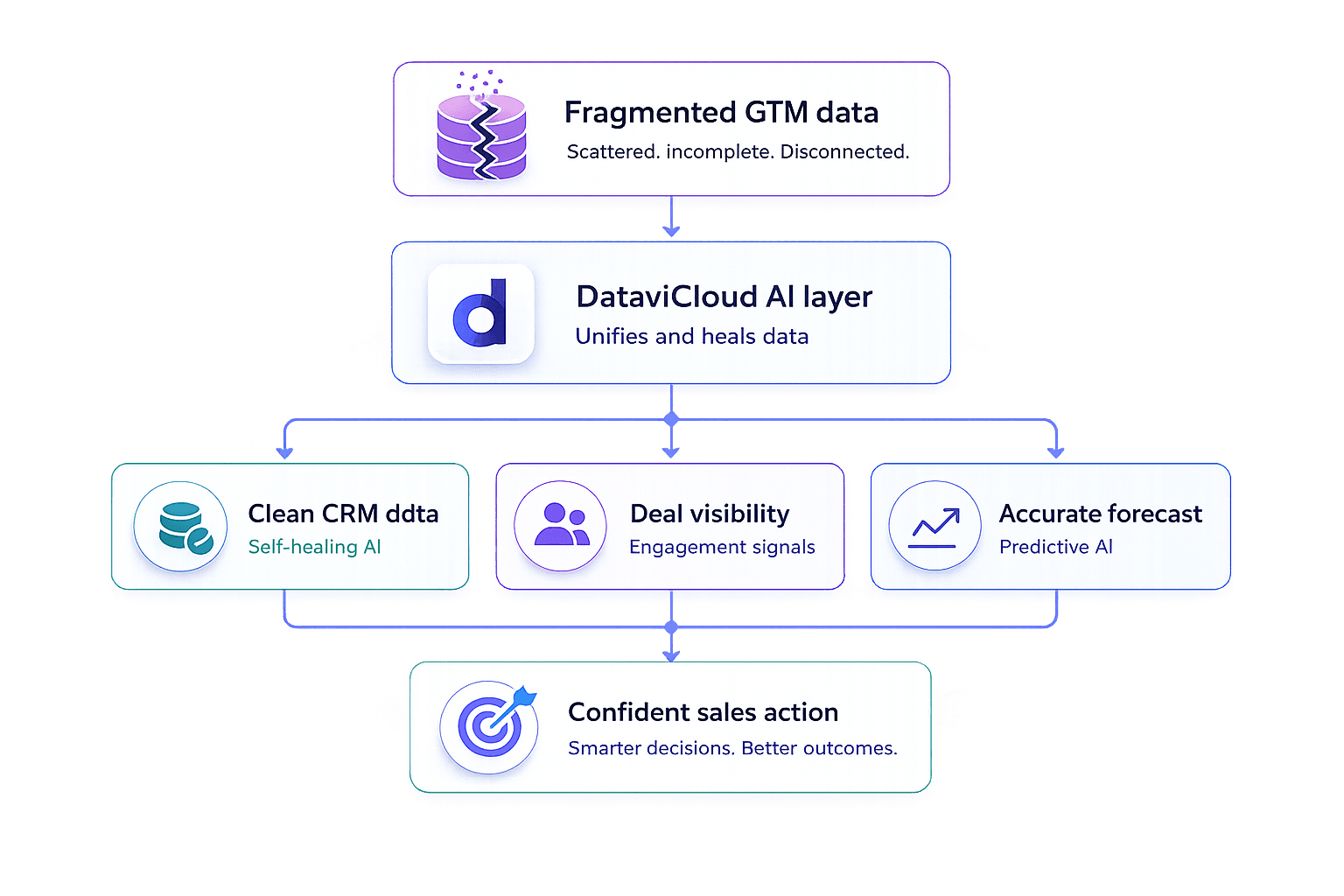
1. Continuous, Agentic AI CRM Hygiene
Periodic data cleanup projects treat symptoms rather than the disease. Next-generation RevOps engines leverage purpose-built Revenue AI Agents (such as the LEO Agent and Phoenix Lead Recycler) to continuously audit CRM entities in real time cross-referencing buyer activity with market changes to update missing fields, merge duplicate records, and verify contact validity automatically.
2. Multi-Touch Pipeline Visibility & Content Alignment
Relying solely on rep-entered notes creates visibility gaps. By consolidating buyer signals across web behavior, email correspondence, and call intelligence, RevOps teams gain an objective, data-backed view of account engagement. Furthermore, with solutions like Content AirCover, GTM teams automatically bridge content gaps to ensure buyers receive the right collateral at every stage of the sales cycle.
3. Predictive AI Revenue Forecasting
Traditional stage-based forecasting relies heavily on rep intuition. Combining historical conversion benchmarks with verified buyer engagement and data completeness scores via DataviCloud Pricing & Platform Features enables revenue leaders to replace speculative "best case" projections with 95%+ forecast precision.
RevOps Transition Framework: 4 Steps to Data Stack Modernization
Transitioning from a fragmented prospecting setup to a unified revenue layer requires a structured, phased implementation plan:
Conduct a CRM Data Health Audit: Measure your baseline data decay rate by reviewing email bounce percentages, duplicate record volumes, and inactive accounts sitting in mid-funnel stages without logged activity for over 30 days.
Establish a Single Source of Truth: Configure clear bi-directional sync rules across your GTM stack on DataviCloud to ensure your primary CRM remains the definitive repository for account activity, preventing shadow data silos.
Deploy Continuous AI Data Auto-Healing: Deploy background Revenue AI Agents that continuously verify contact details, track job changes among key champions, and eliminate manual data entry overhead for reps.
Unify Signals for Predictive Execution: Connect conversational intelligence, intent data, and CRM touchpoints into a unified intelligence engine to score account readiness and generate board-ready revenue projections.
Executive Diagnostic & Next Steps
Assess your GTM data architecture by asking your leadership team three key questions:
Seller Efficiency: Are your account executives spending more time manually verifying contact details and updating records than engaging qualified buyers?
Pipeline Velocity: Can your sales management team clearly explain, using verified activity data, why top enterprise opportunities are currently moving or stalled?
Forecast Accuracy: Would your quarter-end forecast withstand rigorous questioning from your CFO based on objective pipeline completeness scores?
High-volume prospecting databases still serve a clear function for top-of-funnel outbound campaigns. However, scaling an enterprise GTM engine requires an intelligent unification layer on DataviCloud to clean, orchestrate, and operationalize account data once it enters your CRM ecosystem.
Conclusion & Next Steps
High-volume prospecting databases still serve a clear function for top-of-funnel outbound campaigns. However, scaling an enterprise GTM engine requires an intelligent unification layer to clean, orchestrate, and operationalize account data once it enters your CRM ecosystem.
By shifting focus from static lead volume to continuous data quality, RevOps leaders can reduce seller burnout, decrease bounce rates, and transform their CRM into a reliable engine for long-term growth.
Recent Post





FAQ
Comment Section