
Who is Your Real ICP? Your CRM Already Knows the Answer

Who is Your Real ICP? Your CRM Already Knows the Answer
Stop building your ICP from assumptions. Start with the customers already driving your revenue.
If you’re in GTM, you’ve probably seen a variation of this scenario: your sales team is chasing ‘ICP’ accounts that look perfect on paper. Six touchpoints, great firmographics, responded to the webinar—except that these deals are going nowhere. Meanwhile, a mid-market company you barely targeted closed in 3 weeks.
ICP vs Reality: The Slow Drift
Nobody’s debating why ICP is important in sales anymore—we’ve all seen what a strong one can do for pipeline and growth. What many teams continue to grapple with is this: how to ensure your ICP is a good reflection of reality, one that is focusing your marketing efforts in the right direction.
Early ICPs—or ECPs—are typically built using a mix of early customer profiles, internal hypotheses, and marketing intuition. None of these inputs are inherently flawed, but they are often untested by experience.
Reality has a way of drifting from our well-thought out narratives. Six months down the line, marketing continues to generate leads that die in discovery and sales teams are chasing accounts that are simply not converting.
Meanwhile, there’s one place where evidence of your real ICP is building steadily—your CRM, which is accumulating buying behavior across every deal won, lost, or stalled.
Your CRM, the goldmine of ICP signals
If you want a data-driven ICP, your CRM is the most underused asset in your stack.
At the surface level, you can see which company sizes, industries, and regions show up in closed-won deals. Go deeper—sales cycle length, deal size, number of stakeholders—and you start seeing not just who buys, but how they buy.
Engagement patterns add another layer. Did they consume three whitepapers or jump straight to a demo? Did they trial for two weeks or ghost after the first call? These aren't vanity metrics, they’re your signals.
Then there's the unstructured gold: sales calls, email threads, Slack conversations, discovery notes. This is where you find out why someone bought, or why they didn’t.
Plenty of material to work with—and once you’ve done the work, you will have a pretty accurate idea of your real ICP, instead of the fantasy ICP you workshopped on a whiteboard last year.
This isn't a one-and-done analysis. Your ICP evolves as your product, market, and customer base change. Each cycle sharpens your understanding—what started as a broad hypothesis becomes a precise, data-backed definition.
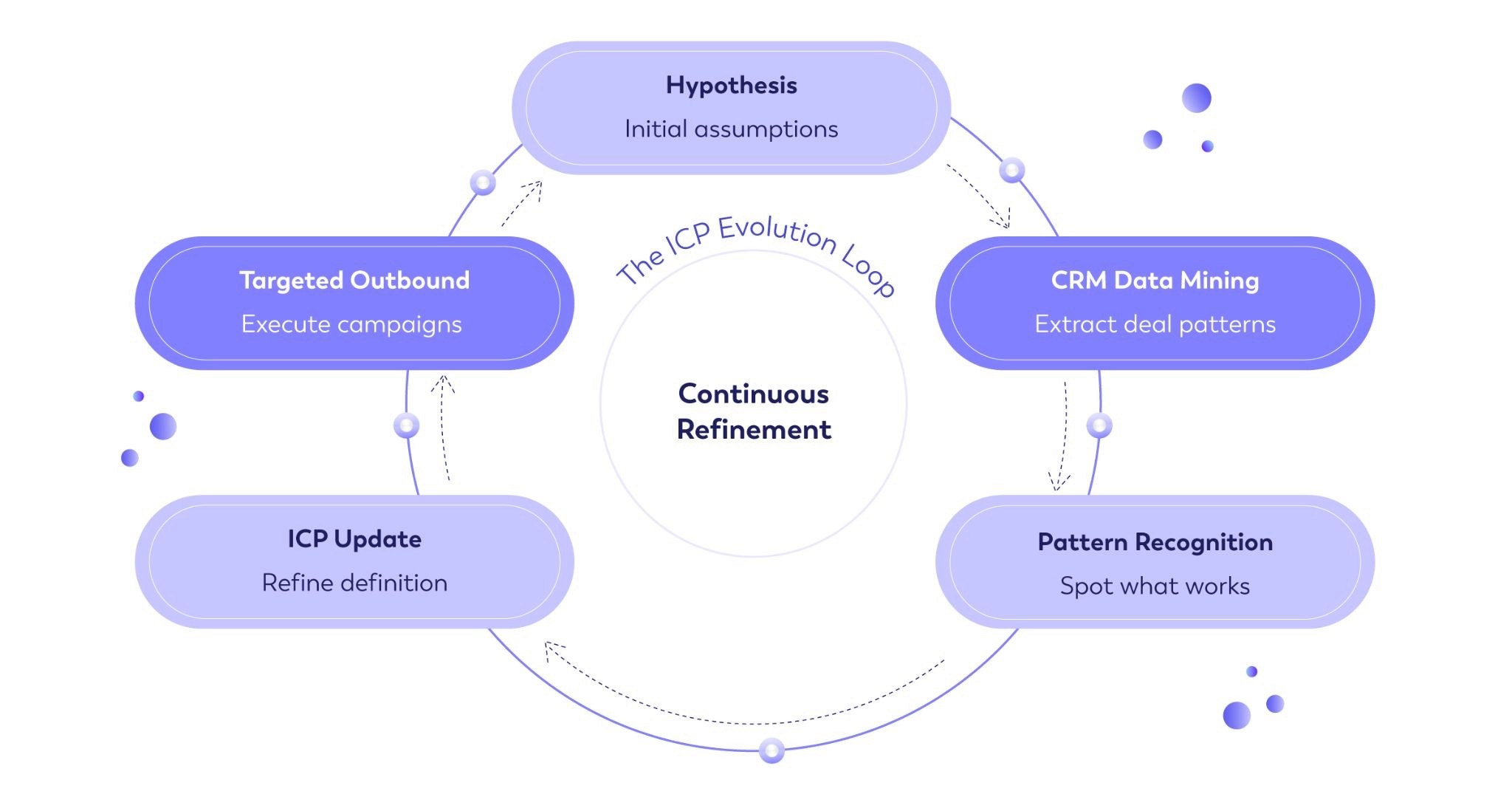
How to Build a Data-Driven ICP Using CRM Data
The framework is straightforward: who converts fastest, who buys the most, and who stays the longest? That's your ICP. Here’s a step-by-step ICP analysis framework you can use.
Step 1: Analyze Your Closed-Won Deals (the best ones, not the average ones)
Look at Closed-Won Deals to see who is buying—keeping in mind that not all customers are equally valuable when it comes to defining your ICP. The goal isn’t to understand your average deal. It’s to understand your best ones.
Start by isolating the top 20–30% of deals by revenue, along with those that closed quickly and have shown strong retention. These are your strongest indicators of fit. When you analyze them collectively, coherent patterns tend to emerge.
You might find, for instance, that a disproportionate number of high-value deals come from B2B SaaS companies in the 100–500 employee range. Or that companies actively hiring data engineers are far more likely to convert. Or that your fastest deals all came from companies already using Snowflake. Not Databricks, not Redshift—Snowflake. That's a filter you can act on.
This is what a real ICP looks like—not "mid-sized tech companies."
Step 2: Study Lost Deals
If closed-won deals show you where you fit, lost deals show you where you don’t. Quite often, lost deals are written off as missed opportunities, rather than analyzed as structured feedback. But the absence of conversion is just as informative as its presence—lost deals tell you where to stop spending time. That's just as valuable as knowing where to double down.
When you look closely, you may see some patterns. For instance:
Certain industries consistently fail to convert.
Larger enterprises might engage deeply—attending demos, requesting proposals—only to stall indefinitely.
Some segments may require long sales cycles that rarely justify the effort.
Enterprise accounts generate excitement but rarely close, while mid-market companies move quickly from interest to decision.
This kind of sales pipeline analysis often reveals inefficiencies in your lead qualification strategy and offers insights to reshape your B2B sales strategy: how you allocate sales effort, qualify pipeline, and define success.
Step 3: Identify High-Velocity Segments
Speed matters. When a deal moves from demo to contract in under 30 days, it's not just good sales execution—it's product-market fit showing up in your pipeline data. That's your ICP talking.
Speed, in this context, is not just a sales metric. It’s a proxy for fit. Where deals move quickly, friction is low. And where friction is low, your product and your customer are naturally aligned, creating a fertile ground for conversion.
Step 4: Look Beyond the Sale to Expansion and Retention
Conversion is only part of the story. Some customers buy quickly but never expand. Others take longer to close but go on to become your most valuable accounts.
If your ICP is based solely on who signs the contract, you risk optimizing for the wrong outcome. A more complete view looks at what happens after the deal closes. Which accounts expand over time? Which ones adopt the product deeply? Which segments show the lowest churn? This is where customer lifetime value (CLV) and churn analysis come into play.
Your true ICP sits at the intersection of conversion, retention, and expansion. Anything less is a partial picture.
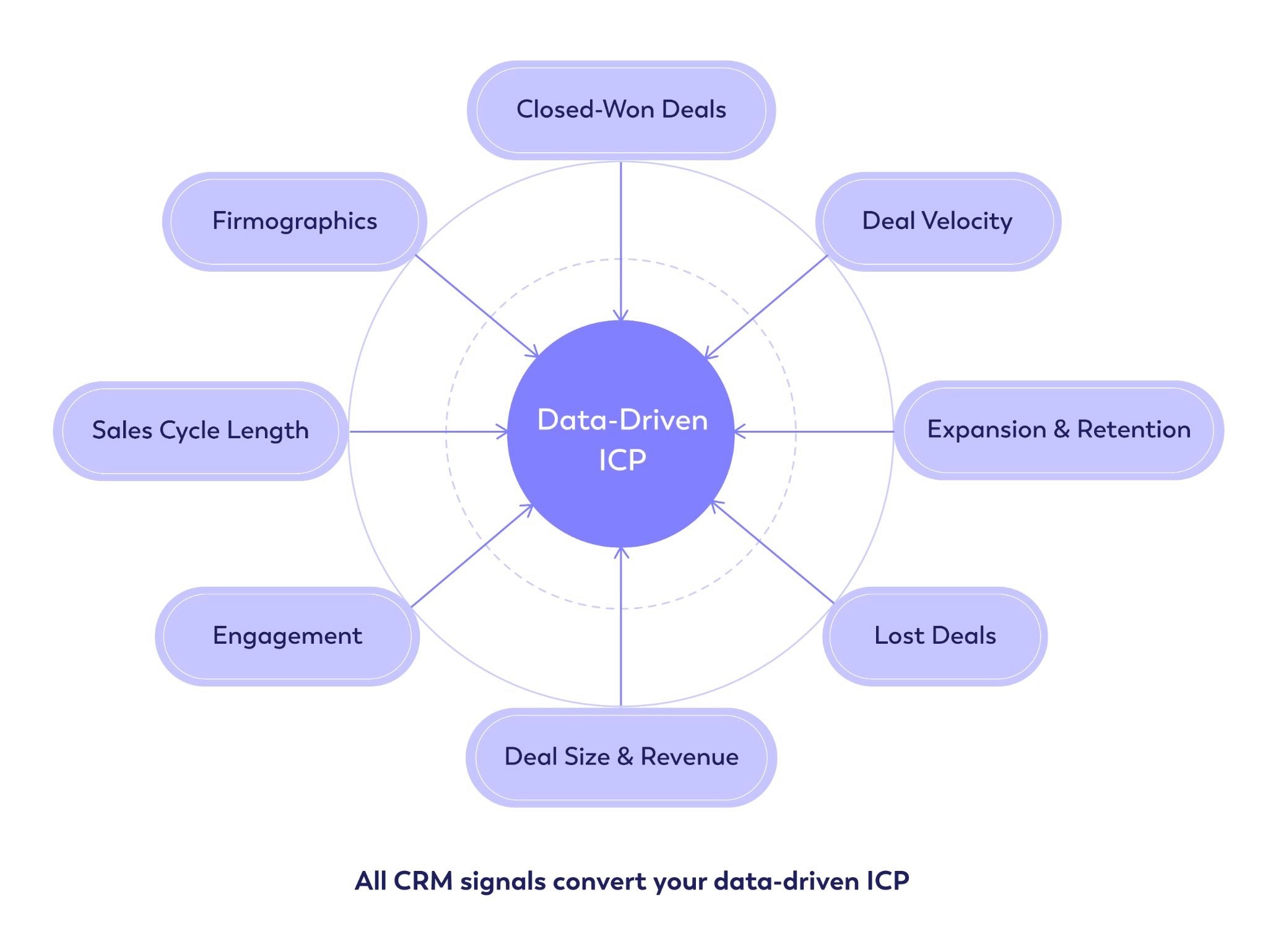
Step 5: Build a Data-Driven ICP
Once these patterns are clear, your ICP begins to shift from broad description to precise definition. This is the essence of a strong ICP framework and robust ICP analysis.
Instead of “mid-sized tech companies,” you may arrive at something more specific: B2B SaaS companies with 100–500 employees, actively hiring data engineers, and already using platforms like Snowflake.
This level of clarity has immediate downstream impact. Targeting becomes sharper and outbound becomes more efficient. Campaigns resonate more deeply because they are rooted in actual customer behavior, not assumptions.
Alignment improves as well. When sales, marketing, and product are working from the same evidence-based definition, decision-making becomes faster and far less contentious. It also enables more focused account-based marketing (ABM) efforts.
Where Datavi Comes In
The logic behind minding your CRM to find your ICP is straightforward. The execution is not.
CRM data is messy. Fields are blank. Notes say "follow up soon. The insight is there, but it's scattered across structured fields, unstructured notes, and disconnected tools.
This is what we built Datavi for. We analyze historical deal data at scale, structure the chaos from sales conversations, and surface the patterns your team can't see manually. We turn your CRM from a record-keeping system into a source of competitive advantage.
Your best customers are trying to tell you who they are. Your CRM is listening. The question is, are you?
Recent Post



FAQ
Comment Section