
Ready or not, LinkedIn Enforcements Are Reshaping Outbound.
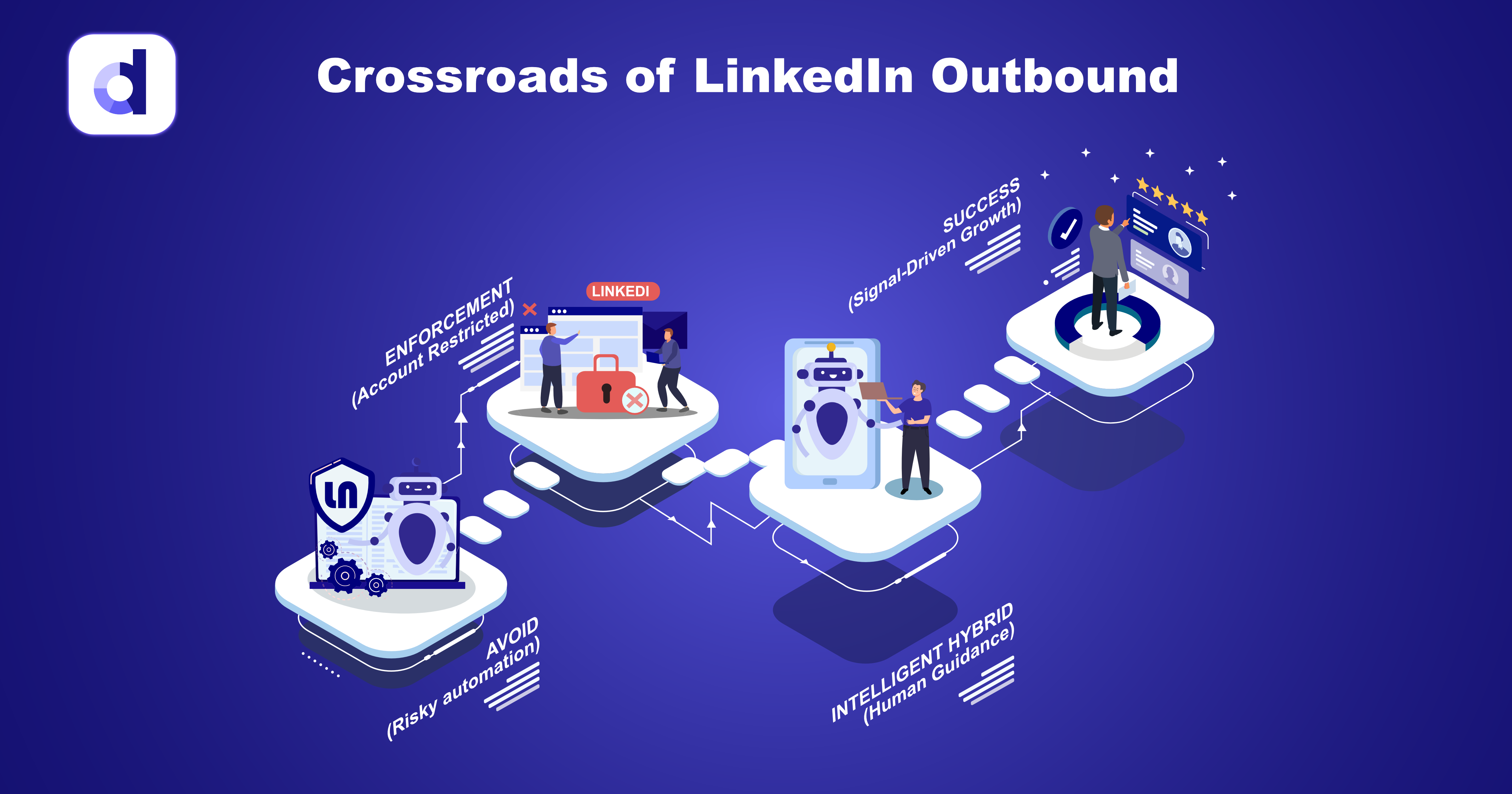
Ready or not, LinkedIn Enforcements Are Reshaping Outbound.
What has changed, what still works—and how to tread the fine line between manual and automated outreach on LinkedIn.
It’s not an easy time to be a B2B SDR prospecting on LinkedIn. You might have noticed that outreach is getting harder—despite all the tools that have proliferated to make it easier.
What worked when LinkedIn was less saturated, doesn’t move the needle much anymore. Today, most decision-makers receive multiple cold messages per week, many of which sound just like each other, with personalization barely scratching the surface. As a result, connection acceptance rates are lower than ever. In order to compensate for this, you might be relying more on volume and relentless follow-ups. But higher activity does not necessarily translate to better results—especially as LinkedIn automation limits and platform enforcement have become more visible in recent years.
As though that weren’t enough—last year, LinkedIn restricted major outreach platforms from accessing parts of its ecosystem. LinkedIn argued that these tools were scraping large volumes of profile data and enabling automated outreach workflows that bypassed its platform safeguards. Over time, tools like these had become a routine part of outbound operations. When LinkedIn curtailed that access, many automated outreach capabilities were suddenly constrained.
This crackdown wasn’t a one-off. LinkedIn’s value depends on preserving professional trust and it is constantly on the watch for anything that dilutes this trust. As a result, it penalizes activity that resembles machine-generated noise—such as large-scale automated outreach, aggressive scraping activity, or templated InMails.
These changes have also brought greater scrutiny to LinkedIn scraping detection, the use of automation tools, and the broader LinkedIn automation risk that SDR teams must now manage.
What LinkedIn’s enforcement looks like
LinkedIn’s enforcement strategy isn’t always as absolute as account suspension. Enforcement can either be explicit (account-level penalties) or implicit (reduced effectiveness). LinkedIn rarely announces enforcement actions publicly, but it surfaces restrictions operationally.
Gradual reduction in LinkedIn weekly invitation limit
Lower LinkedIn connection limit per day
Temporary account suspensions pending verification
Forced password resets or session invalidations
These restrictions may also be early warning indicators of LinkedIn account restriction—what many SDRs informally call LinkedIn jail. Understanding these triggers has become a critical part of managing LinkedIn automation risk.
Enforcement Triggers | |
Trigger | LinkedIn’s response |
Sudden activity spike | Weekly invitation warning |
Low acceptance rate | Invitation limits |
Multiple login locations | Account review |
Identical messaging | Message throttling |
Should you not automate outreach, then?
Short answer: You should.
When faced with the risks of automation, some teams respond by abandoning it entirely. Others double down, hoping scale compensates for friction. Both extremes have limitations.
Approach | Strengths | Weaknesses |
Automation | • Scalable outreach • Consistency across SDR teams • Measurable cadence performance | • Predictable behavioral patterns • Limited contextual awareness • Platform compliance risk when overused |
Manual Outreach | • Deep personalization • Real-time adaptability Stronger relationship building | • Limited scalability • Inconsistent execution quality • High SDR time investment |
This tension has fueled the debate around manual vs automated LinkedIn outreach. As always, the most effective solution is somewhere in the middle. Automation is not inherently flawed and manual outreach is not inherently superior. The real problem is automation without intelligence layered into it.
What Still Works on LinkedIn: Intelligent hybrid outreach
Teams that continue to see results on LinkedIn aren’t doing anything dramatic, they’re simply more deliberate.
The pattern that emerges across high-performing teams is a hybrid approach: automation provides structure and scale, while human judgment shapes timing, messaging, and escalation. Instead of rigid, calendar-based sequences, you follow signal-driven outbound, where outreach is adjusted based on signals—how prospects engage, what content they interact with, and whether they show signs of intent.
Here are some golden rules that will serve you well in your hybrid outreach efforts.
Golden Rule 1: Ramp activity gradually and maintain clean login behavior.
LinkedIn clamps down on unnatural behavior—sudden jumps in connection volume, logging in from multiple locations, or multiple people accessing the same account.
Solution: Increase activity slowly, keep login patterns consistent, and assign one owner per profile. According to one Redditor, keeping daily connection requests under roughly 20–25 and warming up new accounts slowly reduces flagging issues.
Activity | Conservative | Moderate | High Risk |
|---|---|---|---|
Daily Invites | 10–20 | 20–30 | 40+ |
Weekly Invites | <100 | 100–150 | 200+ |
Acceptance Rate | 40%+ | 30–40% | <25% |
Follow-Ups | Max 3 | 3–4 | 5+ |
Golden Rule 2: Engage with prospects before sending a connection request.
Says Smitha Gowda, Senior SDR Manager at Datavicloud: “ I’ve learned that LinkedIn outreach works best when you stop approaching prospects as complete strangers and know whom you are targeting. Even a small interaction, a comment or reaction, puts your name on their radar. When that’s combined with reaching out to the right ICP and referencing something relevant to them, the connection request feels far more natural.”
It could be as simple as a thoughtful comment on a recent post or briefly reacting to a product launch update. “Saw your post about scaling the data team” or “Enjoyed your take on GTM tooling”—is a far more credible opening than a generic note.
Golden Rule 3: Avoid identical templates and patterned behaviour.
Using identical templates across multiple SDR accounts also increases pattern visibility. Teams that continue to perform vary phrasing, adjust timing slightly, and blend automated touches with manual engagement.
Golden Rule 4: Adjust your calendar based on signals.
Many automated sequences operate on fixed calendars. For example,
Day 1: Connect
Day 3: Follow up
Day 6: Nudge
Day 10: Final attempt
These sequences may continue even when the prospect has ignored all prior messages, changed roles, or even already spoken to someone internally. There is no suppression logic and no escalation logic. No behavioral adaptation based on signals. This is what invites trouble.
LinkedIn works best when reinforced by email, calls, or other touchpoints as part of coordinated cross-channel outreach. Once a prospect responds on any channel, automated follow-ups should stop everywhere. Overlapping outreach from multiple team members talks of poor coordination and reduces credibility.
Golden Rule 5: Use automation for structure, not for judgment
One consistent theme from many SDRs in the Reddit trenches is that the risk is not automation itself—it is automation that removes judgment.
As one Redditor described it, a “copiloted” approach works better than full automation: tools can queue tasks, organize leads, and schedule actions at human-paced intervals, but the actual execution remains manual. It takes slightly longer, but it stays within platform norms and often performs better.
Generic templates such as “I noticed we’re both in [industry]” are both widely recognized and frequently ignored—which is why actual messages and contextual decisions benefit from human oversight.
LinkedIn Outreach Risk ScoreA 60-Second Self-Assessment for Revenue Teams ☐ Are we sending more than 30 connection requests per day from a single account? ☐Is our connection acceptance rate below the typical LinkedIn acceptance rate benchmark (~30%)? ☐ Are SDRs using identical templates across multiple accounts? ☐ Are multiple team members contacting the same prospects with similar outreach patterns? ☐ Do automated follow-ups continue even after a prospect responds? ☐ Are we logging in from multiple locations, devices, or IP addresses for the same LinkedIn account? ☐ Did a new account ramp from 0 to high activity in just a few days? ☐ Are we sending links or long sales messages in the first outreach message? ☐ Are our daily activity levels inconsistent (quiet for days, then sudden bursts)? ☐ Are we shifting channels randomly (email, LinkedIn, calls) without clear behavioral triggers? |
Parting Thoughts: Signal-driven orchestration
If you step back, the recurring theme across all of this activity is how coordinated your LinkedIn activity is. Most of the enforcement risks, performance drops, and diminishing returns we discussed are not caused by automation alone. They are caused by isolated automation—LinkedIn operating as a silo, disconnected from behavioral signals, intent data, or broader sequencing logic.
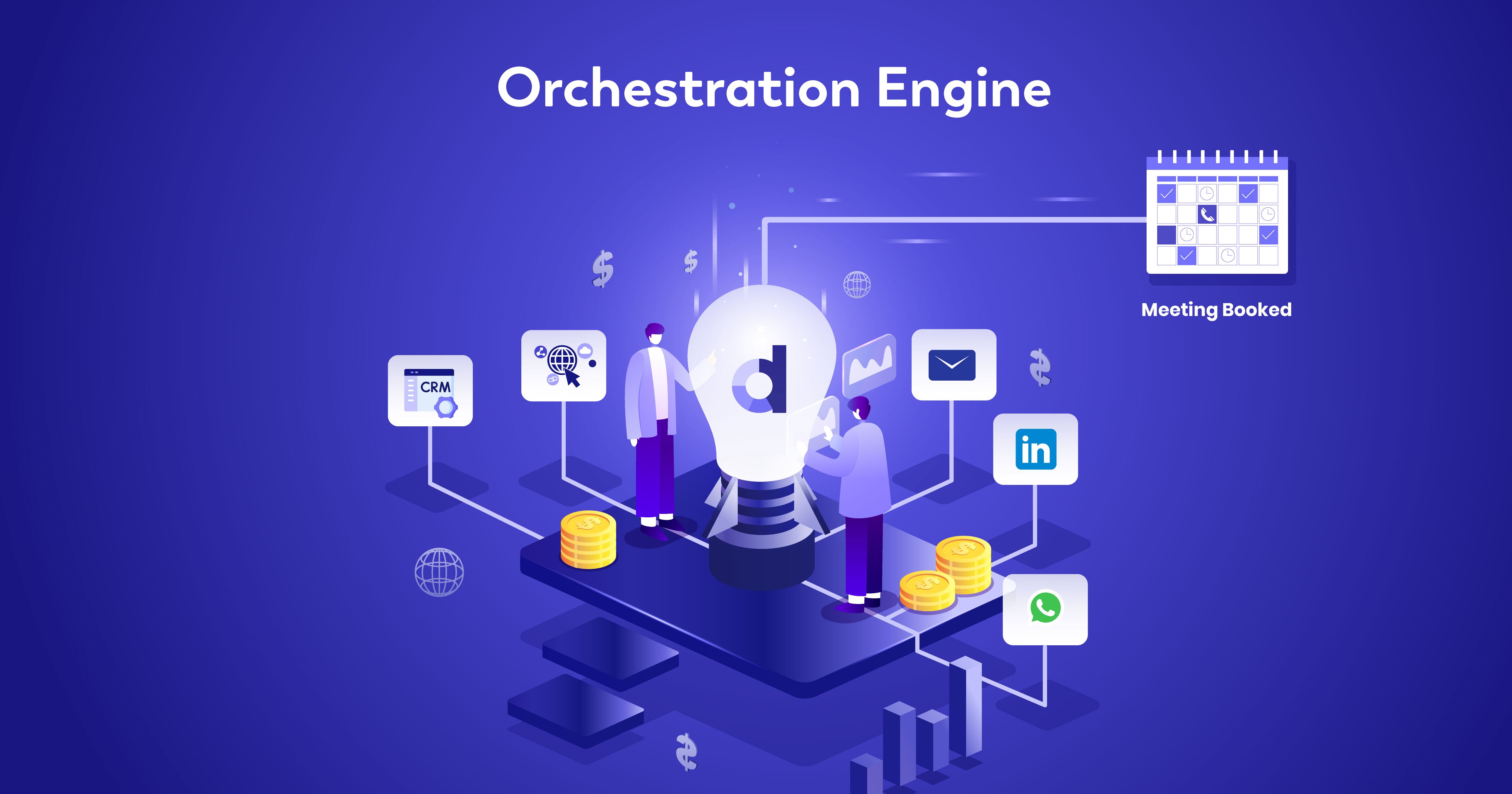
Modern revenue teams increasingly approach LinkedIn as one component within a broader revenue orchestration framework, with some essential components:
Unified data visibility
Intent signal aggregation
Cross-channel sequencing
Suppression and escalation logic
Role-based routing
With these in place, LinkedIn becomes one coordinated touchpoint inside a larger GTM orchestration system. Teams that evolve toward signal-driven outbound—rather than tool-based scaling—will continue to see results, regardless of LinkedIn’s policy shifts.
In short, automation still works. It simply works best when embedded within intelligence.
Recent Post




FAQ
Comment Section