
WhatsApp B2B Outreach in 2026 : The New Outbound Frontier
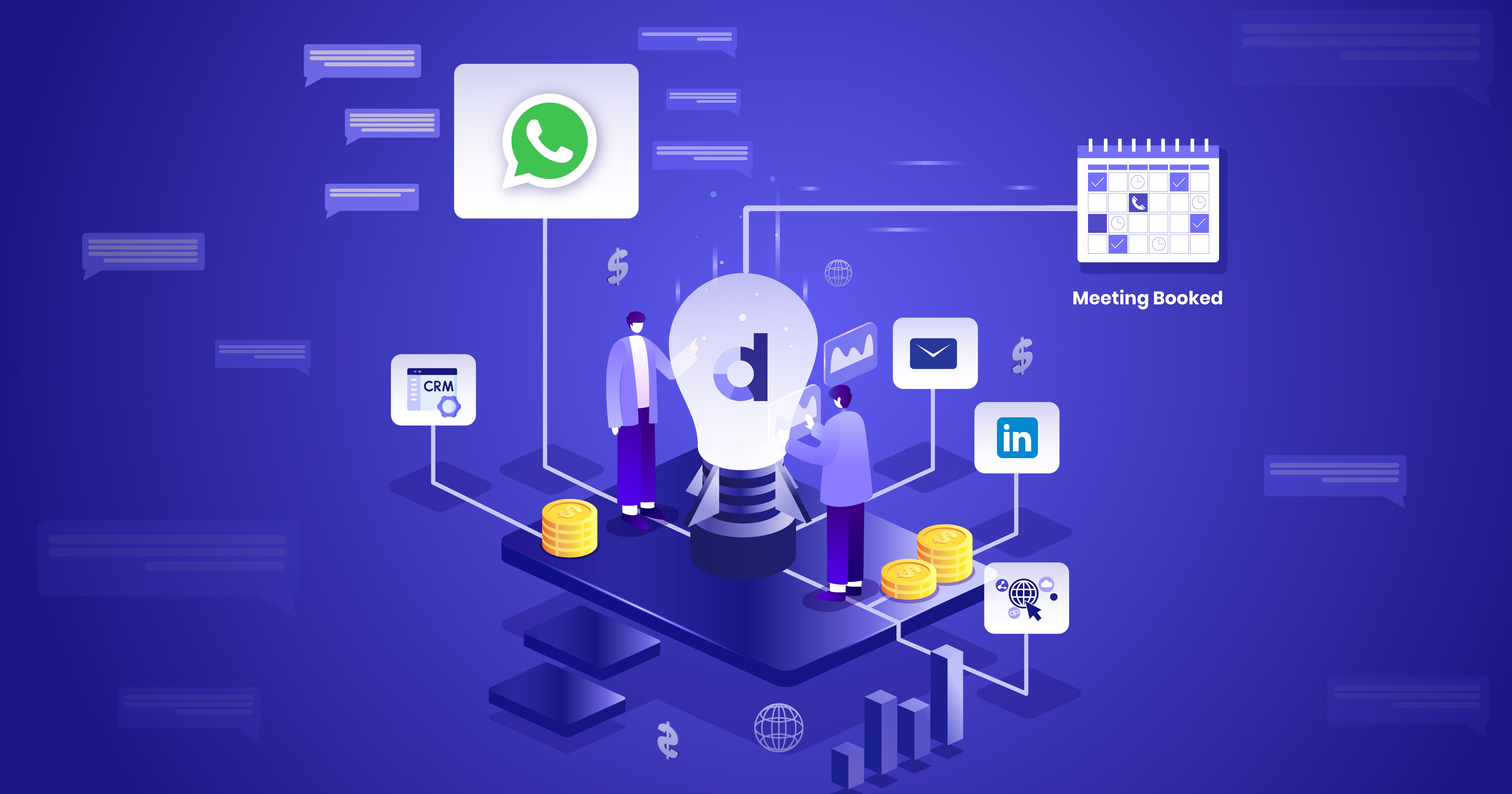
WhatsApp B2B Outreach: The New Outbound Frontier
WhatsApp B2B outreach is here to stay—but GTM teams should proceed with caution and consideration.
True story: WhatsApp wasn’t originally intended as a messaging app. In 2009, former Yahoo employees Brian Acton and Jan Koum launched it as a simple iPhone app that showed a status beside each contact—literally answering the question, “What’s up?” (hence the name!).
In a serendipitous move, a few months later, iPhone introduced push notification tech, and WhatsApp users began to use the app to send funny status updates to each other. It was then that it evolved into a messaging app. Nearly 9 years later, it evolved again, with the introduction of WhatsApp Business and WhatsApp Business API.
From a lightweight app developed for friends to stay in touch, to a serious outreach channel, WhatsApp has come a long way!
98% Open Rate: The GTM Team’s Dream
Today’s mail inboxes are crowded to bursting, and social media platforms like LinkedIn have tightened enforcement. In this environment, WhatsApp can feel like the B2B marketer’s Holy Grail.
The appeal is obvious. WhatsApp famously has an open rate of 98%. Almost every message you send on it is opened immediately. Compare that to email’s will-they-won’t-they average open rate of 15%.
But like most things that sound too good to be true, there’s a catch. Unlike email, which buyers often tolerate as a semi-public communication channel, WhatsApp occupies a firmly personal space. This makes WhatsApp far less forgiving of poor outreach. And as more companies experiment with WhatsApp sales outreach, the line between effective communication and intrusive messaging is becoming increasingly thin.
In this post, we’re going to look at why WhatsApp B2B outreach is so compelling, why it can be detrimental, and how to use it judiciously as an adjunct to traditional outreach channels.
Why WhatsApp Is Great For Business
WhatsApp’s effectiveness in business communication comes down to a few structural advantages.
1. Near-instant open rates
Messages on WhatsApp are typically opened within minutes. Most users keep notifications enabled and check messages frequently throughout the day.
2. A conversational environment
WhatsApp is built for dialogue. When people reply on the platform, they tend to write the way they speak—and this makes exchanges feel less like sales and more like a conversation.
3. Direct access
Email inboxes are crowded. Social platforms are governed by algorithms. WhatsApp messages, by contrast, arrive directly on a person’s phone. There are no ranking systems determining visibility and no inbox categories filtering the message away.
4. Mobile-first communication
Many decision-makers now handle quick interactions on their phones throughout the day, and WhatsApp fits naturally into this rhythm. A quick WhatsApp message is often easier to respond to than an email buried in the inbox.
In many ways, WhatsApp compresses the distance between companies and buyers.
That is—unless you go about it the wrong way
Despite its advantages, WhatsApp B2B outreach can quickly backfire when misused. The rise of WhatsApp sales automation tools has only amplified this problem, making it easier for teams to scale outreach—but also easier to trigger spam detection and user backlash.
Unsolicited outreach
Messaging people who never opted in is one of the fastest ways to trigger negative reactions.
WhatsApp treats contacting users without consent as spam behaviour. If recipients frequently ignore, delete, or block your messages, the platform lowers your quality rating and can restrict or suspend your ability to send messages.
Overly promotional messages
WhatsApp is designed for conversation, not advertising. Messages that feel like aggressive sales pitches are more likely to be flagged or reported by recipients.
Spam-like messaging patterns
Sending large volumes of identical messages, blasting contacts quickly, or repeating the same pitch can trigger automated spam detection systems.
Compliance and policy violations
Like many other platforms, WhatsApp has increasingly tightened its enforcement around business messaging. Companies that use the official WhatsApp Business API must adhere to specific rules designed to prevent spam and protect user experience. For instance, strict requirements around opt-in messaging, where users must explicitly consent before being contacted.
Using WhatsApp judiciously
The central principle is this: You can and should use WhatsApp to accelerate ongoing conversations.
However, you should not be using it for first touches, and you should not be using it as a substitute for discovery. The key is to treat it as a relationship-first medium that supports lead nurturing, rather than another prospecting tool.
Rule 1: Earn the number first
WhatsApp works when a relationship already exists. Only message people who have given their number voluntarily. Use WhatsApp after a conversation, referral, demo, or event.
Avoid scraping numbers or messaging cold leads to protect credibility and avoid blocks.
Rule 2: Keep messages short, clear, and conversational
One to three lines is optimal, and personal, natural language works best. Avoid writing long paragraphs or sales letters.Messages that are concise and direct feel natural. Messages that attempt to compress a full sales pitch into a chat window rarely work. Here are a couple of WhatsApp outreach examples to illustrate the difference:
Less effective
Hi there, I wanted to introduce our platform that helps revenue teams automate pipeline generation and improve outreach efficiency…
More effective
Hi there—we spoke at SaaStr yesterday.
Sharing the report I mentioned.
Rule 3: Use WhatsApp for progression, not prospecting
The most effective WhatsApp follow-up messages are those that build on an existing interaction rather than introducing a new pitch. Use it to focus on next steps, clarification, and coordination. Common use cases include:
Scheduling or confirming meetings
Sharing quick resources or links
Clarifying details after a demo
Continuing a conversation that began elsewhere
Rule 4: Be considerate of timing
Timing matters across all platforms, but particularly so with WhatsApp, as it invades the recipient’s personal space instantly. Send messages during business hours. Avoid nights, weekends, or holidays unless explicitly agreed upon.
WhatsApp in multi-channel orchestration
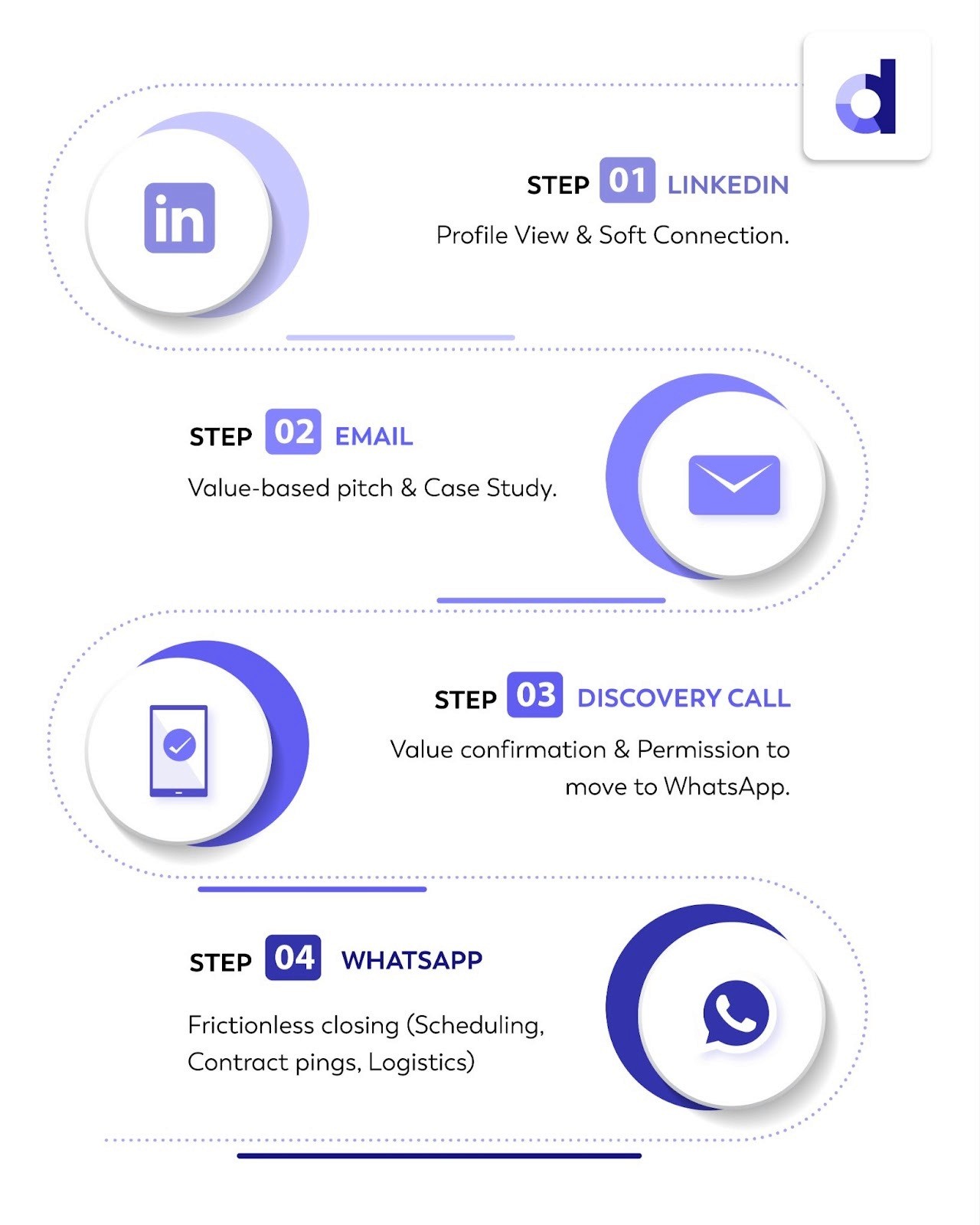
The most effective WhatsApp B2B outreach strategies don’t operate in isolation—they’re part of a broader system. In modern multi-channel outreach, no single platform owns the entire buyer journey. Each channel plays a different role across the sales funnel, and WhatsApp’s role is clear: it accelerates momentum once a conversation is already in motion.
This becomes even more relevant in account-based marketing (ABM) contexts, where high-touch communication is standard practice.
Outreach Channel | Average Open Rate | Response Speed | Primary Role in Funnel | Primary Risk |
30–40% | Medium (12h+) | Top of Funnel (Initial touch) | Account restriction | |
Cold Email | 15–25% | Slow (24h+) | Early–Mid Funnel (Depth & nurture) | Deliverability/Spam filters |
WhatsApp B2B | 90–98% | Instant (<5 min) | Mid–Late Funnel (Progression & coordination) | Blocks / quality rating decline |
A typical progression might look like this:
With proximity comes responsibility
It comes down to this: WhatsApp brings you closer to your buyer—but with that comes responsible use. The same channel that speeds things up can also shut things down.
Recent Post




FAQ
Comment Section