Jan 22, 2026

Maximimize your event marketing ROI

Maximimize your event marketing ROI

Maximimize your event marketing ROI

Maximimize your event marketing ROI

Maximimize your event marketing ROI

Sales rep responding to a lead notification on a mobile device with high speed

Maximimize your event marketing ROI

How to turn events into meetings, pipeline, and revenue in 30 days.

If you’ve been part of B2B event marketing, you know the buzz that follows a successful event, online or offline. The world looks wide open and your prospects look warm and ready for business. Sadly, all that optimism sputters to a halt a few weeks later—as you realize the chasm between event energy and back-to-the-office pragmatism.

Event success isn’t high registrations or high attendance. Registration is merely the top of a funnel. The outcome we want is for it to convert to meetings and real revenue, within 30 days or so of the event.

 In this post, we’re talking about how to get to this outcome in a thoughtful, structured way. 

  1. Pre‑event promotion

  2. Post‑event follow‑up and a sample playbook.

  3. Attended vs. no‑show nurture tracks

The Three Numbers That Define Modern Event ROI

Before we jump into what to do, let’s ground our attempts in real, recent benchmarks. While event formats vary widely—from in-person field events to large hybrid conferences—the benchmarks below are primarily drawn from B2B webinars, where attendance, engagement, and follow-up can be measured most consistently.

Metric

What It Tells You

Benchmarks

Registration → Attendance

Whether your event promise and reminders were strong enough to earn real time, not just sign-ups.

40–50% is typical for B2B webinars. Strong programs reach 55–60%.

Attendance → Engagement

Whether the content actually resonated with your ICP (attention beats presence).

70–80% stay for ≥50% of the session. 30–40% engage via polls or Q&A.

Event → Meetings (≤30 days)

Whether the event created sales momentum—or just momentary interest.

10–20% of attendees convert to meetings within 30 days. Top teams exceed 25%.

*Benchmarks compiled from ON24, GoToWebinar, Goldcast, HubSpot, Adobe, and Salesforce B2B marketing studies.

Step 1: Pre‑Event Promotion

Build registrations. Also build intent. 

A strong pre-event promotion cadence doesn’t just remind people an event exists—it frames the conversation you want to continue after the event.

A high-intent pre-event sequence looks like this:

  • T-14 days | The Why-Now
    Establish urgency. What has changed in the market, buyer behaviour, or regulatory landscape that makes this topic relevant today?

  • T-7 days | Social Proof
    Reinforce relevance through peers, customer logos, speakers, or roles attending. Buyers want to know who else finds this worth their time.

  • T-3 days | What You’ll Walk Away With
    Be explicit. List 3–5 concrete takeaways. Avoid vague promises like “insights” or “best practices.”

  • T-1 day | Calendar + Reminder
    Reduce friction. Include calendar links and clarify whether a recording will be available (this often increases registrations without hurting attendance).

  • T-2 hours | Final Nudge
    A short, skimmable reminder with the join link and a single sentence on why it’s worth showing up live.

When done well, pre-event promotion doesn’t just boost attendance—it ensures the right people attend, which directly improves downstream conversion.

Step 2: Post‑Event Follow‑Up

When time is of the essence.

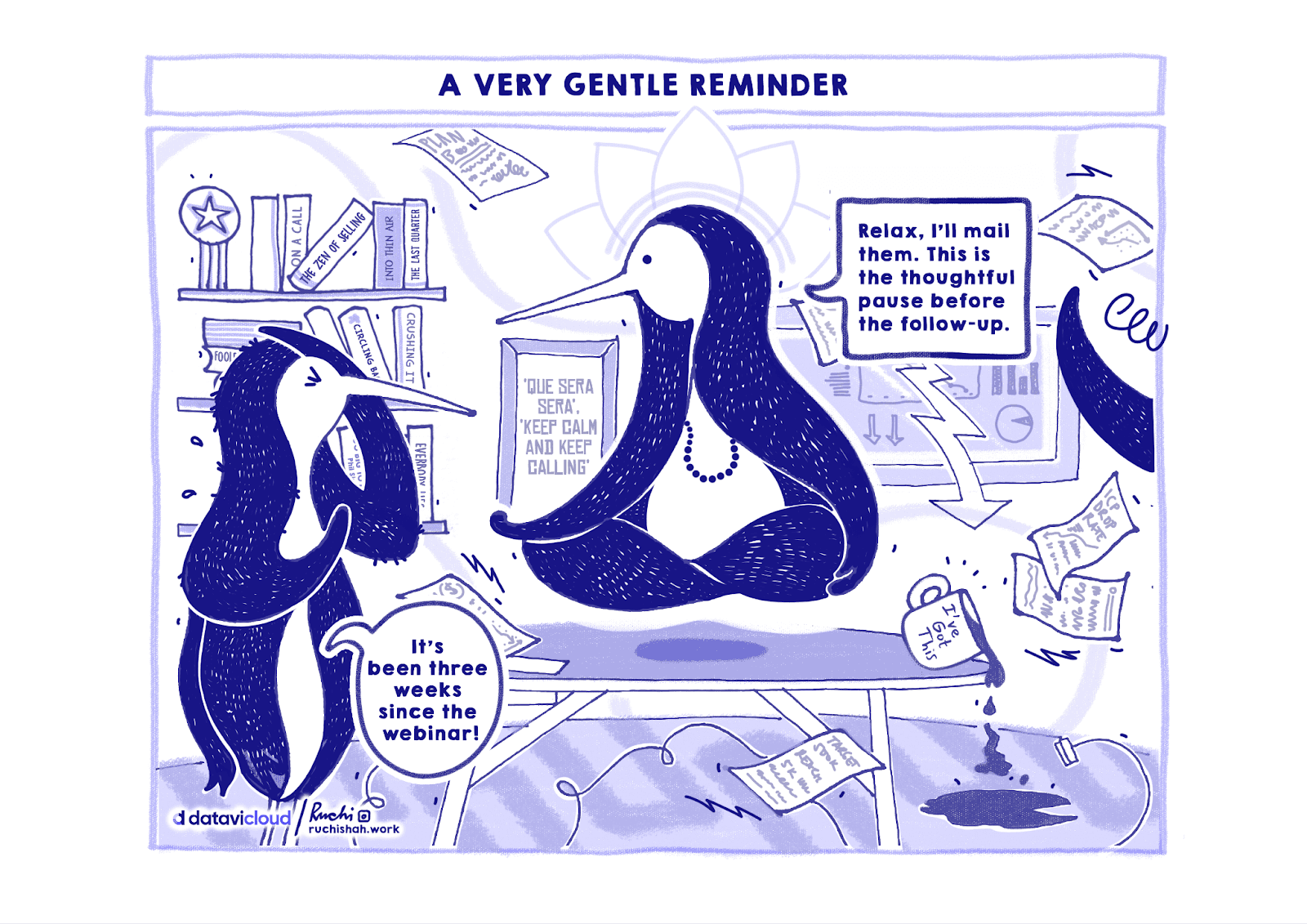
Events create a spike in interest—but that interest decays quickly once buyers return to their day jobs. 
Infographic showing conversion rate drop-off after 5 minutes of lead wait time

The truth: follow-up delays are one of the biggest reasons event leads fail to convert into pipeline. Post-event outreach works best when it feels like a continuation of the event, not a reset. 

Effective post-event follow-up should be:

  • Personalized
    Reference the session attended, a poll response, or a question asked. Even light personalization signals relevance.

  • Fast
    Aim for 24–48 hours post-event. After that, recall and urgency drop sharply.

  • Action-oriented
    Don’t just say “happy to chat.” Offer a clear next step: a short call, a deeper resource, or a specific use-case discussion.

During this critical post-event period, keep track of any and all intent signals—website activity ( hits on pricing, docs, comparison pages, demo pages), outreach engagement (link clicks, replies, LinkedIn engagement), partial signups etc. 

Note: Datavicloud’s tool, LEO (Lead Enrichment and Outreach), can help you monitor and respond to these intent signals rapidly. 

Step 3: Attended and no‑show Nurture Tracks

Don’t put apples and oranges into the same basket.

Treating all registrants the same is one of the biggest event ROI killers. Their behavior signals very different states of intent.

Track A: Attended

Attendees gave you their time—arguably the most expensive currency. These leads are generally higher intent and more likely to convert. Your outreach here should:

  • Reference something specific from the event

  • Build directly on the topic discussed

  • Propose a short, logical next step

Track B: Registered but No‑Show

No-shows aren’t disengaged, they’re probably just distracted. They signed up for a reason, but something else took over. Your job is to make re-engagement easy, not awkward.

Effective no-show nurture:

  • Acknowledges absence without guilt

  • Shares a concise takeaway or short recap

  • Offers a low-friction next step: for instance, are you free for a quick call?

The 30‑Day Post-Event Playbook

Every event creates a short-lived window where:

  • Buyer recall is high

  • The problem discussed still feels urgent

  • Your brand is top-of-mind without needing repeated justification

Here’s a simple event ROI playbook mapped to buyer behavior, not internal workflows:

Window

Priority

Day 0–3

Fast, personalized post-event follow-up

Day 4–10

Contextual reminders + SDR/AE outreach

Day 11–30

Decide: nurture forward or sunset

Day 0–3: Strike While the Context Is Warm

This is the highest-leverage period in the entire event lifecycle. Buyers still remember why they registered, and what resonated with them during the session.  

What works best in this window:

  • Referencing the specific session attended

  • Acknowledging a poll response or Q&A theme

  • Offering a next step that feels like a natural continuation

Day 4–10: Reinforce, Don’t Repeat

By this point, buyers are back in execution mode. The event isn’t front-of-mind—but it’s not forgotten either. This is where light persistence with relevance matters.

Effective actions in this phase include:

  • A concise reminder tied to one insight from the event

  • Sharing a relevant resource, clip, or use case

  • SDR or AE outreach that acknowledges prior communication instead of restarting the thread

The mistake to avoid here is repetition. You’re not reminding them the event happened—you’re reminding them why it mattered.

Day 11–30: Make a Clear Decision

By now, buyer behavior is telling you something. Either they engaged and moved forward. Or they went quiet, which means it’s time for you to deprioritize in the interest of your pipeline health. 

If nothing happens within 30 days, you likely lost the momentum event marketing created. High-performing teams accept this reality. They optimize for speed, relevance, and decisiveness—knowing that event ROI is won or lost after the event, not during it.

Clear exit criteria here protect both your brand credibility and your sales team’s time.

Event marketing is a predictable revenue motion when engineered well. Don’t get stuck on vanity metrics like raw registrations, email opens, or social impressions. Focus on revenue‑aligned outcomes:

  • Meetings booked within 30 days

  • Pipeline created
    Closed deals influenced by the event

  • Percentage of attendees who engaged in next‑stage discussions

How has event marketing worked for your GTM org? We’d love to hear your on-the-ground insights in the comments section.

FAQ

FAQ

FAQ

FAQ

Frequently Asked Questions

Frequently Asked Questions

Frequently Asked Questions

Frequently Asked Questions

Why is event marketing ROI historically so difficult to measure?

Not at all. Qurie is your "Pocket Analyst" designed for natural language. You can ask complex questions like, "Which accounts have high product usage but low spend?" and receive instant, visualized data. It bridges the gap between raw data and executive action without needing a data science team.

Why is event marketing ROI historically so difficult to measure?

Not at all. Qurie is your "Pocket Analyst" designed for natural language. You can ask complex questions like, "Which accounts have high product usage but low spend?" and receive instant, visualized data. It bridges the gap between raw data and executive action without needing a data science team.

Why is event marketing ROI historically so difficult to measure?

Not at all. Qurie is your "Pocket Analyst" designed for natural language. You can ask complex questions like, "Which accounts have high product usage but low spend?" and receive instant, visualized data. It bridges the gap between raw data and executive action without needing a data science team.

Why is event marketing ROI historically so difficult to measure?

Not at all. Qurie is your "Pocket Analyst" designed for natural language. You can ask complex questions like, "Which accounts have high product usage but low spend?" and receive instant, visualized data. It bridges the gap between raw data and executive action without needing a data science team.

How do you calculate the actual ROI of a B2B event?

Not at all. Qurie is your "Pocket Analyst" designed for natural language. You can ask complex questions like, "Which accounts have high product usage but low spend?" and receive instant, visualized data. It bridges the gap between raw data and executive action without needing a data science team.

How do you calculate the actual ROI of a B2B event?

Not at all. Qurie is your "Pocket Analyst" designed for natural language. You can ask complex questions like, "Which accounts have high product usage but low spend?" and receive instant, visualized data. It bridges the gap between raw data and executive action without needing a data science team.

How do you calculate the actual ROI of a B2B event?

Not at all. Qurie is your "Pocket Analyst" designed for natural language. You can ask complex questions like, "Which accounts have high product usage but low spend?" and receive instant, visualized data. It bridges the gap between raw data and executive action without needing a data science team.

How do you calculate the actual ROI of a B2B event?

Not at all. Qurie is your "Pocket Analyst" designed for natural language. You can ask complex questions like, "Which accounts have high product usage but low spend?" and receive instant, visualized data. It bridges the gap between raw data and executive action without needing a data science team.

What is the biggest mistake companies make with event lead generation?

Not at all. Qurie is your "Pocket Analyst" designed for natural language. You can ask complex questions like, "Which accounts have high product usage but low spend?" and receive instant, visualized data. It bridges the gap between raw data and executive action without needing a data science team.

What is the biggest mistake companies make with event lead generation?

Not at all. Qurie is your "Pocket Analyst" designed for natural language. You can ask complex questions like, "Which accounts have high product usage but low spend?" and receive instant, visualized data. It bridges the gap between raw data and executive action without needing a data science team.

What is the biggest mistake companies make with event lead generation?

Not at all. Qurie is your "Pocket Analyst" designed for natural language. You can ask complex questions like, "Which accounts have high product usage but low spend?" and receive instant, visualized data. It bridges the gap between raw data and executive action without needing a data science team.

What is the biggest mistake companies make with event lead generation?

Not at all. Qurie is your "Pocket Analyst" designed for natural language. You can ask complex questions like, "Which accounts have high product usage but low spend?" and receive instant, visualized data. It bridges the gap between raw data and executive action without needing a data science team.

Can AI actually improve my event marketing performance?

Not at all. Qurie is your "Pocket Analyst" designed for natural language. You can ask complex questions like, "Which accounts have high product usage but low spend?" and receive instant, visualized data. It bridges the gap between raw data and executive action without needing a data science team.

Can AI actually improve my event marketing performance?

Not at all. Qurie is your "Pocket Analyst" designed for natural language. You can ask complex questions like, "Which accounts have high product usage but low spend?" and receive instant, visualized data. It bridges the gap between raw data and executive action without needing a data science team.

Can AI actually improve my event marketing performance?

Not at all. Qurie is your "Pocket Analyst" designed for natural language. You can ask complex questions like, "Which accounts have high product usage but low spend?" and receive instant, visualized data. It bridges the gap between raw data and executive action without needing a data science team.

Can AI actually improve my event marketing performance?

Not at all. Qurie is your "Pocket Analyst" designed for natural language. You can ask complex questions like, "Which accounts have high product usage but low spend?" and receive instant, visualized data. It bridges the gap between raw data and executive action without needing a data science team.

How long should it take to see revenue from a marketing event?

Not at all. Qurie is your "Pocket Analyst" designed for natural language. You can ask complex questions like, "Which accounts have high product usage but low spend?" and receive instant, visualized data. It bridges the gap between raw data and executive action without needing a data science team.

How long should it take to see revenue from a marketing event?

Not at all. Qurie is your "Pocket Analyst" designed for natural language. You can ask complex questions like, "Which accounts have high product usage but low spend?" and receive instant, visualized data. It bridges the gap between raw data and executive action without needing a data science team.

How long should it take to see revenue from a marketing event?

Not at all. Qurie is your "Pocket Analyst" designed for natural language. You can ask complex questions like, "Which accounts have high product usage but low spend?" and receive instant, visualized data. It bridges the gap between raw data and executive action without needing a data science team.

How long should it take to see revenue from a marketing event?

Not at all. Qurie is your "Pocket Analyst" designed for natural language. You can ask complex questions like, "Which accounts have high product usage but low spend?" and receive instant, visualized data. It bridges the gap between raw data and executive action without needing a data science team.

What are the best tools for tracking real-time event analytics?

Not at all. Qurie is your "Pocket Analyst" designed for natural language. You can ask complex questions like, "Which accounts have high product usage but low spend?" and receive instant, visualized data. It bridges the gap between raw data and executive action without needing a data science team.

What are the best tools for tracking real-time event analytics?

Not at all. Qurie is your "Pocket Analyst" designed for natural language. You can ask complex questions like, "Which accounts have high product usage but low spend?" and receive instant, visualized data. It bridges the gap between raw data and executive action without needing a data science team.

What are the best tools for tracking real-time event analytics?

Not at all. Qurie is your "Pocket Analyst" designed for natural language. You can ask complex questions like, "Which accounts have high product usage but low spend?" and receive instant, visualized data. It bridges the gap between raw data and executive action without needing a data science team.

What are the best tools for tracking real-time event analytics?

Not at all. Qurie is your "Pocket Analyst" designed for natural language. You can ask complex questions like, "Which accounts have high product usage but low spend?" and receive instant, visualized data. It bridges the gap between raw data and executive action without needing a data science team.

Comment Section

See you in your inbox?

Ideas, frameworks and updates to help you get real intelligence out of your data.

GTM Operating System powering faster growth and smarter wins.

© 2025 Datavi Cloud, Inc. All right reserved

See you in your inbox?

Ideas, frameworks and updates to help you get real intelligence out of your data.

GTM Operating System powering faster growth and smarter wins.

© 2025 Datavi Cloud, Inc. All right reserved

See you in your inbox?

Ideas, frameworks and updates to help you get real intelligence out of your data.

GTM Operating System powering faster growth and smarter wins.

© 2025 Datavi Cloud, Inc. All right reserved

See you in your inbox?

Ideas, frameworks and updates to help you get real intelligence out of your data.

GTM Operating System powering faster growth and smarter wins.

© 2025 Datavi Cloud, Inc. All right reserved