
Beyond Email: Why Multi-Channel Sequences Convert Better
Beyond Email: Why Multi-Channel Sequences Convert Better
Today’s B2B prospects move swiftly across platforms. GTM teams need to meet them where they are at.
For years, email was the darling of B2B outbound—cost-effective, measurable, and predictable. It still is all of these things, but it’s no longer sufficient on its own. GTM teams that continue to treat email as the primary channel often find themselves working harder for lower response rates.
Many factors have contributed to knocking email off its numero uno pedestal. For one, Google’s tightening of its DMARC policy implementation in late 2023 has hurt inbox deliverability for many brands.
For another, inbox fatigue is real and buyers are splitting their attention across platforms more than ever.
What’s more, buying intent signals are no longer confined to a single channel. A prospect might open an email, browse your website, engage with a LinkedIn post, and revisit your pricing page, all within a short window. If outreach remains isolated within a single channel, it misses this movement.
In this landscape, multi-channel outbound becomes the only sustainable way forward. The impact is significant: studies show that the purchase rate of omnichannel campaigns is 287% higher than single-channel campaigns. Source
Multichannel outreach: What channels are we talking about?
Today’s core B2B outbound stack typically includes Email, LinkedIn, Whatsapp, complemented by phone calls, retargeting efforts, and website engagement tools.
|
|
|
Why Multi-Channel Actually Converts Better
The conversation around multi-channel GTM often gets reduced to one idea: more touchpoints must equal more replies. But it’s not that simplistic. Multi-channel sequences convert better because your context compounds across channels.
Email establishes your core message in a familiar, structured view.
LinkedIn builds recognition and social proof, and reduces your brand’s anonymity.
WhatsApp, when used appropriately, reduces response friction.
When orchestrated well, your prospect encounters you multiple times in succession, and their familiarity with your brand increases. Which means, the probability of a response improves too.
Orchestrating the Multi-Channel Conversation
Email + LinkedIn + WhatsApp: When to Use What
Cold Prospecting (Low Awareness)
Your goal: Establish your presence and basic category clarity.
Start with a focused, value-led email. Follow this with a LinkedIn profile view and connection request to build recognition. If the prospect is active on the platform, engage with a relevant post to create some familiarity. A second email can then reference this context or reiterate value with greater specificity.
Warm Intent (Behavioral Signals Present)
Goal: Convert attention into conversation.
If your prospects are displaying intent signals such as website visits, content downloads, repeated email engagement, or demo requests, escalation becomes appropriate.
At this stage, your outreach should reflect what they’ve already done. Reference the specific page they visited or resource they downloaded. Follow up on LinkedIn while the interaction is still recent. If engagement continues, an SDR call timed to that window is far more likely to connect.
Your shift across channels should follow intent, not merely follow a calendar cadence.
Late-Stage or Active Conversation
Goal: Reduce friction for your prospect.
At this stage, your channel choice should depend on whatever makes it easiest for your prospect to communicate with you. WhatsApp can be useful for scheduling, quick confirmations, or short clarifications. Email remains the right place for documentation, proposals, and formal communication. LinkedIn may support stakeholder mapping if additional decision-makers need to be engaged.
The 15-Day Multi-Channel Execution Timeline
Not all outbound systems are built the same. Most teams operate somewhere along a simple maturity ladder.
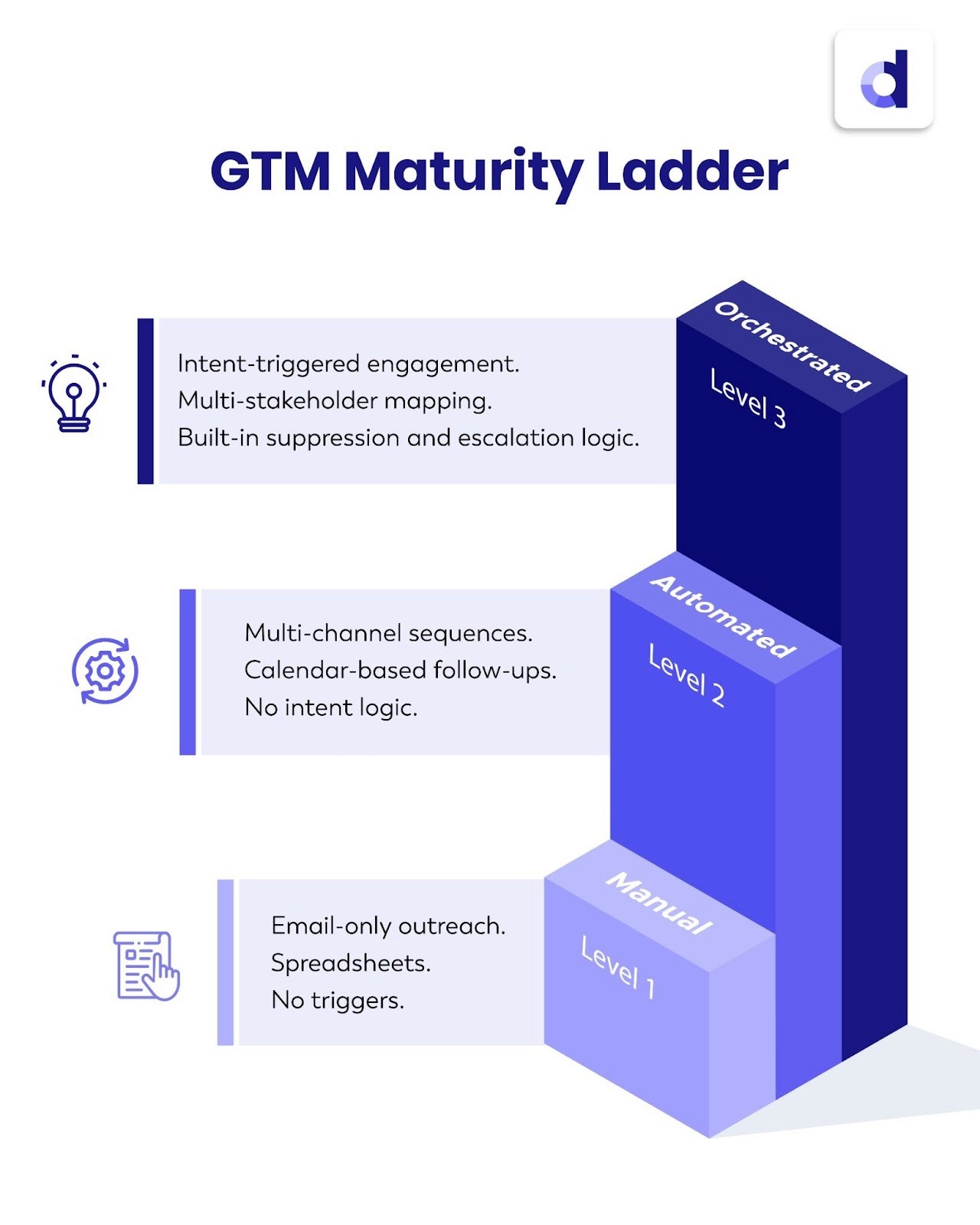
When you’re working at Level 3—orchestrated multi-channel—you reap the real benefits. It is here that you’re winning over prospects, instead of merely communicating more.
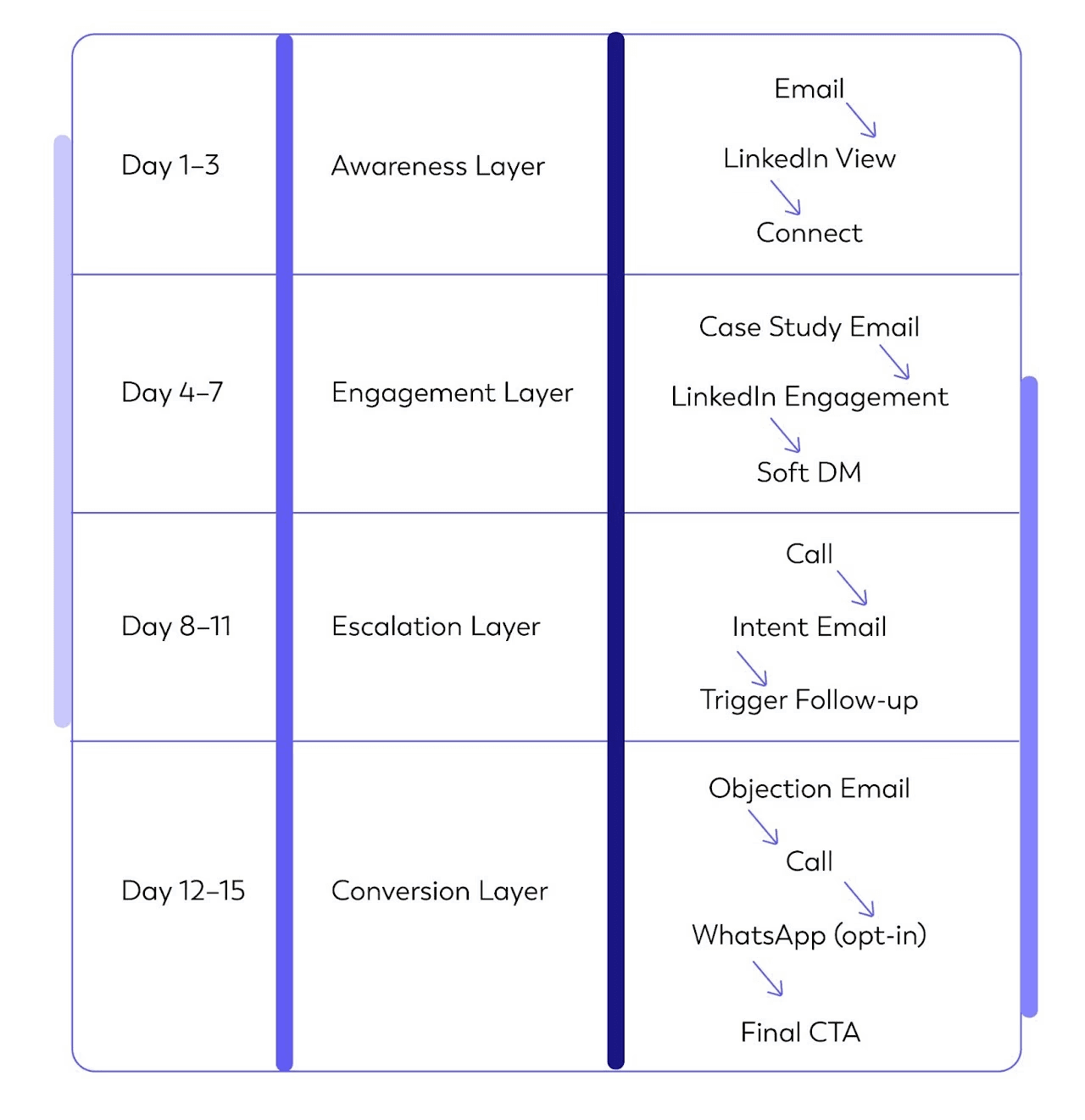
Let’s look at what this might look like in real time. Here’s one of the simplest sales cadence examples for structured multi-channel outbound in action.
Multi-Channel Fatigue and How to Avoid It
Multi-channel outreach is great when designed well. But, if it’s allowed to run amok, it can also create unnecessary noise and turn counter-productive. Here are a few ways in which that can happen.
The same message is copy-pasted across platforms.
Failing to adapt your tone and structure makes your outreach feel low-effort and transactional and reduces credibility.
Suppression logic is absent.
If your prospects continue to receive outreach even after responding, opting out, or engaging through another channel, they are, quite justifiably, going to be annoyed.
Recent interactions are not visible across teams.
Marketing, SDRs, and account executives may be operating from different systems. If a prospect downloads a resource, attends a webinar, or replies to an email, that context does not always flow across tools. As a result, your outreach can appear disconnected from reality.
Channel shifts happen without behavioral triggers.
If your movement between email, LinkedIn, calls, and WhatsApp occurs based on calendar cadence rather than intent signals, your prospects may experience outreach as disjointed.
Outreach tools operate in silos.
If your enrichment platforms, sequencing tools, and CRM systems function independently, the burden of stitching context together falls on your team—and your prospects are bound to feel this fragmentation sooner or later.
How to avoid multi-channel fatigue
1. Escalate based on behavior
If a prospect opens multiple emails, visits your pricing page, or downloads a resource, that behavior justifies escalation. A LinkedIn message or SDR call at that point feels timely because it is grounded in action the buyer has already taken.
Without a behavioral trigger, channel shifts feel arbitrary. The sequence should adapt to the buyer’s movement, not the other way around.
2. Respect channel norms
Each platform has its own expectations. Email allows for structured thinking and detailed articulation. LinkedIn supports lighter, conversational engagement. WhatsApp is immediate and relational, typically suited for coordination rather than introduction.
A long-form email pasted into LinkedIn feels unnatural. A formal, templated message sent over WhatsApp feels out of place. When the same tone and structure are applied everywhere, you’ve likely lost your prospect.
3. Work from a single source of truth
Multi-channel only works well when data flows cleanly across systems. Enrichment data, intent signals, CRM updates, and outreach activity need to live within a unified framework.
This brings us to an important conclusion: Orchestration is the real advantage.
A single operational foundation ensures that when a prospect engages, opts out, books a meeting, or changes status, every channel reflects that update immediately. The GTM teams converting better aren’t just ‘multi-channel’. They are orchestrated multi-channel because they execute from a unified foundation.
This is where we come in. Datavicloud is the GTM operating system you need: a foundational system that handles lead enrichment, signals, and outreach in a cohesive, contextual flow.
If you’d like to understand how Datavicloud can help you achieve seamless, synchronised multi-channel outreach that converts, we’d love to take you through a short demo.
Recent Post



FAQ
Comment Section