
Your GTM Stack Has a Frankenstack Problem

Your GTM Stack Has a Frankenstack Problem
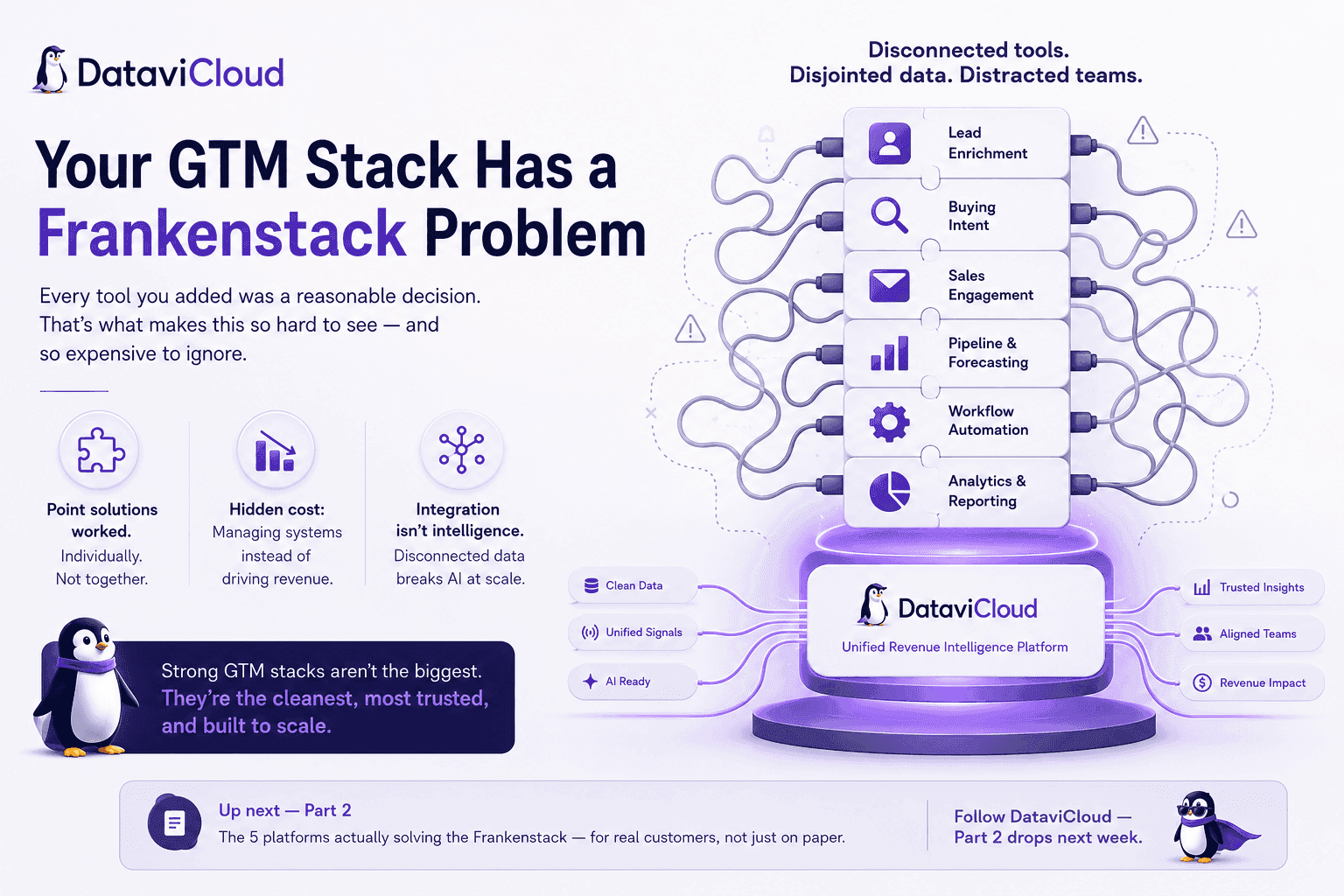
Every tool you added was a reasonable decision. That's what makes this so hard to see — and so expensive to ignore.
How the trap is set
Adding a new GTM tool used to feel like progress. Lead data? Add enrichment. Buying intent? Add a signal tool. Forecasting? Add a dashboard. Automation? Add a workflow layer. And now, AI at every level.
None of these decisions are wrong on their own. The problem is what they become together when managing a B2B go-to-market tech stack optimization strategy.
That's the Frankenstack: a collection of disconnected tools stitched together through integrations, APIs, spreadsheets, and temporary fixes that quietly became permanent architecture. It's not something companies build on purpose. It's something they build one reasonable decision at a time, resulting in severe data fragmentation.
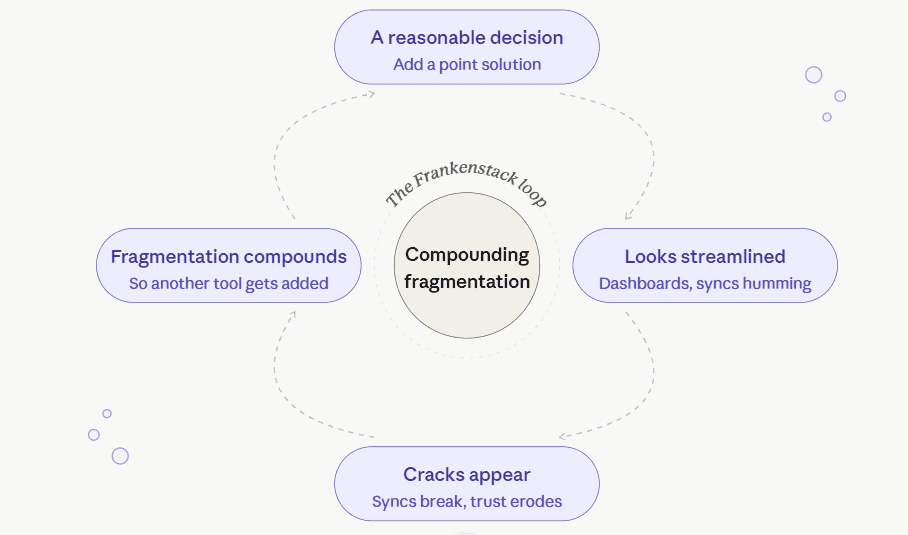
Point solutions work. That's the honest truth, and it's exactly why the problem is so hard to catch. A routing tool improves assignment. An enrichment tool fills data gaps. A sequencing platform lifts outreach. For a while, everything looks streamlined — dashboards clean, integrations humming, workflows functioning.
Then, gradually, the cracks appear. An API update breaks a sync. One platform starts interpreting account data differently, creating isolated data silos. A dashboard shows pipeline numbers that don't match another dashboard. And suddenly the team stops asking, "What does the data show?" and starts asking, "Which version of the data should we trust?"
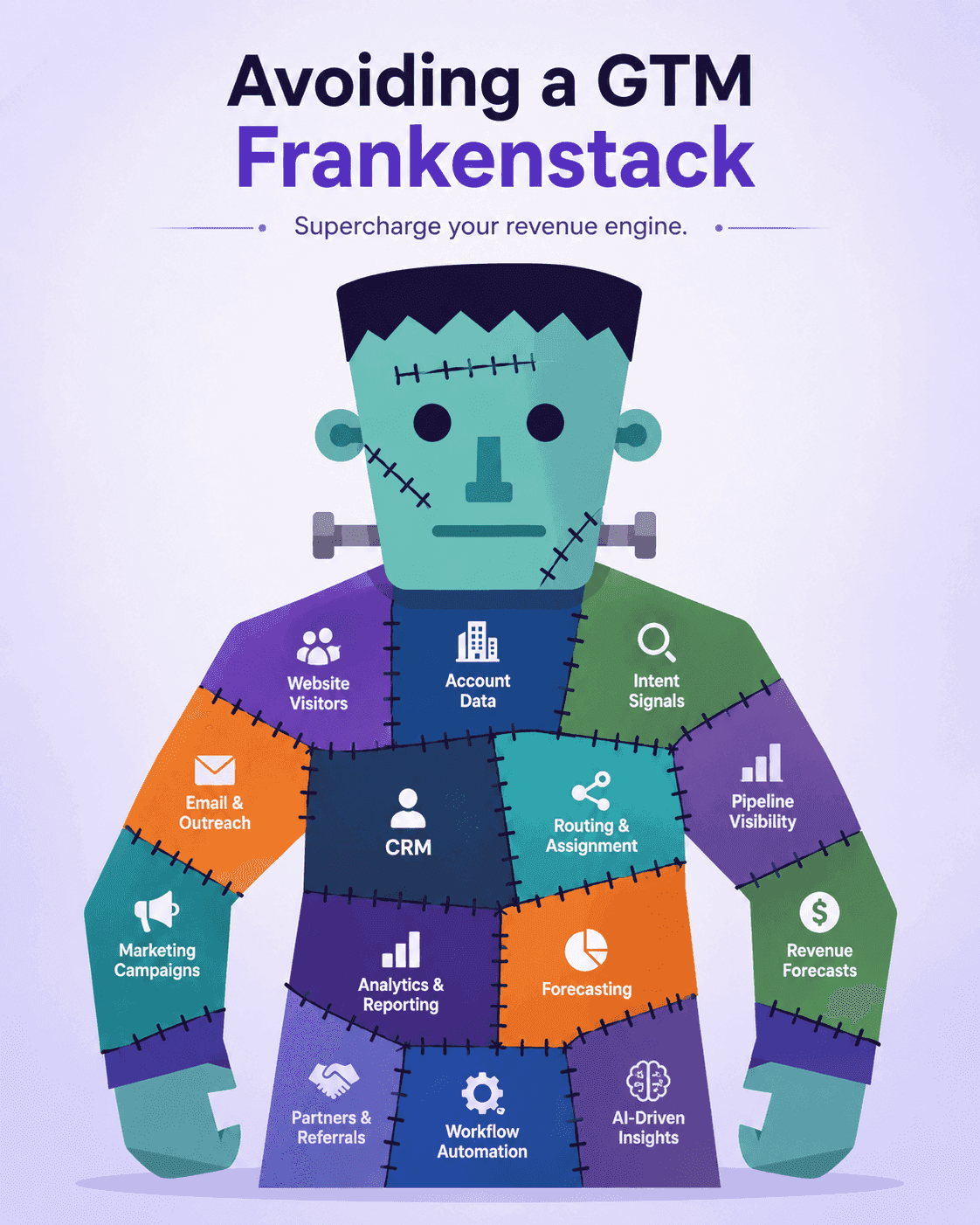
"The problem is rarely the individual tool. It's what happens between the tools — over time."
That erosion of trust is where the real damage happens. Not in a single failure, but in the slow accumulation of doubt.
The hidden cost: managing systems instead of revenue
At a certain scale, keeping a complex GTM stack operational stops being an IT concern and starts consuming the revenue team itself, causing massive revenue leakage. Organizations end up needing custom integrations, middleware layers, data sync monitoring, manual reconciliation, and constant workflow maintenance — just to keep existing operations running.
The question isn't whether data engineering can solve these problems. It's whether revenue teams should need this level of operational overhead just to function, drastically increasing the Total Cost of Ownership (TCO) of SaaS.
Sales teams today are already navigating longer buying cycles, multi-threaded stakeholders, AI-assisted outreach, forecasting pressure, and pipeline unpredictability. The stack's job is to reduce that friction — not add to it.
When GTM teams spend meaningful time managing systems, they're not spending that time on customers or pipeline. That trade-off rarely shows up in any dashboard.
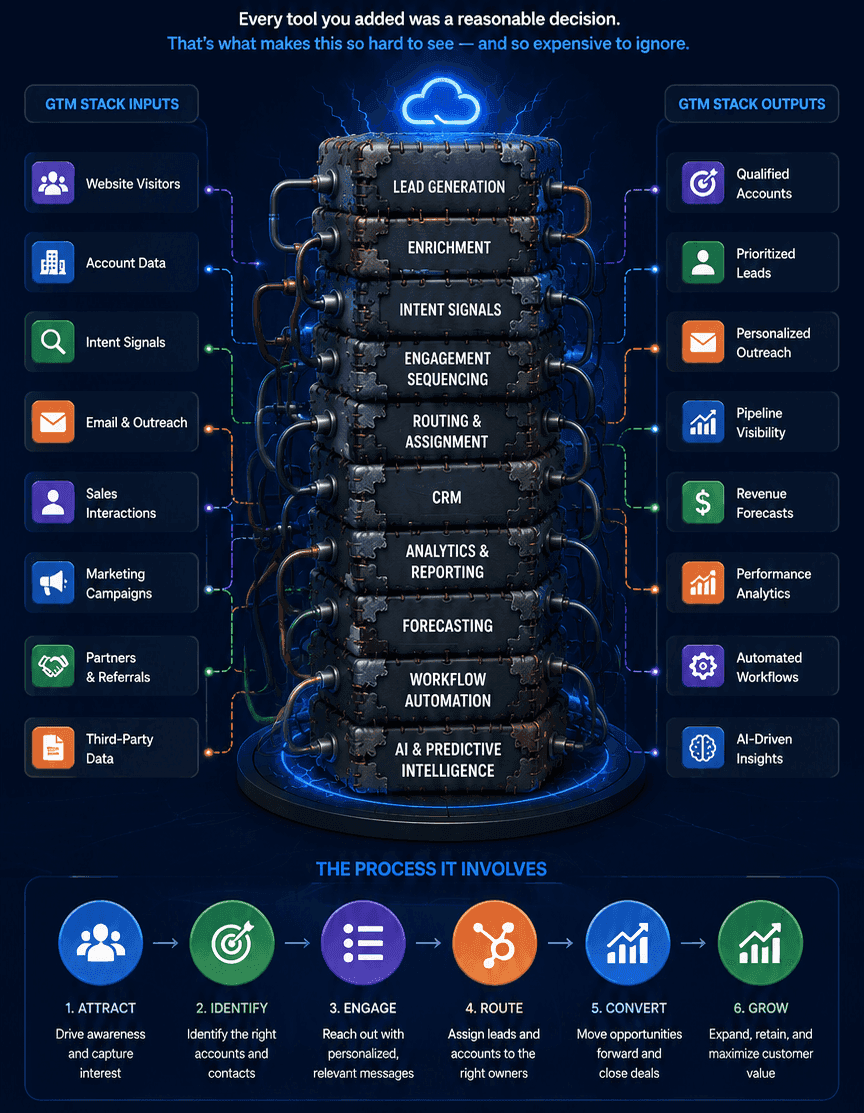
Integration ≠ intelligence
Most modern tools can integrate with each other. That problem is largely solved. The harder problem is whether data flowing between systems actually creates meaningful continuity — or just creates the appearance of it.
Every platform has its own scoring logic, its own attribution model, its own interpretation of the customer journey. So while the stack looks connected on the surface, the intelligence underneath often stays siloed away from your core Customer Relationship Management (CRM) integration.
AI is exposing this faster than anything before it. AI systems depend on consistent signals, unified context, and reliable historical patterns. When every platform sees a different version of the customer, AI outputs become fragmented too. Disconnected systems don't just slow AI down — they produce disconnected intelligence at speed.
Seven questions to ask before adding anything
Most GTM teams evaluate tools on features. Very few evaluate them on operational impact two or three years later. Before the next addition, slow down and work through these:
Is this solving a long-term workflow problem — or a short-term gap? Temporary fixes have a way of becoming permanent architecture. Ask whether this still makes sense as the business scales.
Does this improve the overall revenue workflow, or does it optimize one function in isolation? Marketing may love it. Sales may tolerate it. RevOps may spend months maintaining it. That's how fragmentation starts.
Will this strengthen the data flow — or create another silo? Technical integration doesn't automatically create data alignment. Each new system brings its own reporting logic, attribution model, and truth.
Who owns the single source of truth? If the answer changes depending on who you ask — pipeline in sales, engagement in marketing, intent in RevOps — the stack is already fragmenting.
When this workflow breaks six months from now, who owns fixing it? Integrations that look smooth at implementation often become brittle as teams scale, APIs change, and platforms evolve.
What happens when AI is layered on top? If the underlying systems are fragmented, AI doesn't remove that complexity. It amplifies it — and makes fragmented decisions faster.
Can teams actually trust the data across systems? Once trust disappears, dashboards become noise, forecasting slows, and alignment breaks down. A GTM stack should create clarity — not confusion with better UI.
What to build toward
The goal shouldn't be accumulating point solutions to patch operational gaps as they appear. It should be pursuing RevOps software consolidation to build a revenue ecosystem that holds together as the business grows — systems that communicate consistently, workflows that don't require constant maintenance, data that flows cleanly across teams without someone manually reconciling it every week.
"The strongest GTM stacks aren't the biggest ones. They're the ones with the cleanest orchestration and the clearest visibility."
A problem that finally has a name
The term "Frankenstack" is resonating right now because it names something GTM leaders have felt for years but struggled to articulate cleanly. The market is catching up to a problem that's been hiding in plain sight.
At DataviCloud, this isn't a new conversation for us. It's the one we've been having with revenue teams since we started — long before there was a word for it. The patterns were consistent: not companies that lacked tools, but companies whose tools had quietly stopped working together. The fragmentation was real. The cost was real. It just didn't have a name yet.
What's different now is urgency. AI doesn't paper over disconnected systems — it pressure-tests them. Every layer of AI capability added to a fragmented stack amplifies the fragmentation. And that's finally making the problem too visible to defer.
The companies worth watching over the next few years won't necessarily be the ones with the most sophisticated tools. They'll be the ones that recognised early — often quietly, without fanfare — that continuity, trust, and clean data flow through a unified revenue intelligence platform were the foundation everything else had to be built on.
That work is harder to demo than a new dashboard. But it's the work that actually compounds if you want to implement the best revenue operations tools 2026 has to offer to reduce GTM tool sprawl.
The 5 platforms actually solving the Frankenstack, for real customers, not just on paper
We looked past the marketing. Past the feature lists. At what these platforms actually deliver when a GTM team bets their revenue stack on them. Five platforms. What they get right. What to watch for. And how to know if one of them is right for you. Up next — Part 2
Recent Post





FAQ
Comment Section